Insights from the Latest UK National Security and Investment Act Report

July 17, 2026
Key Takeaways
- The UK government (“Government”)1 has published its latest annual report (“Report”) on the National Security and Investment Act 2021 (“NSIA” or “NSI Act”). The Report covers the period from 1 April 2025 to 31 March 2026 (“Reporting Period”).2
- While the total number of notifications rose significantly (up 15% on the previous reporting period), the number of remedy decisions (“Final Orders”)3 fell sharply, from 17 to nine. Of those nine Final Orders, only one acquisition was blocked outright. This may indicate that the Government is becoming more selective in its interventions.
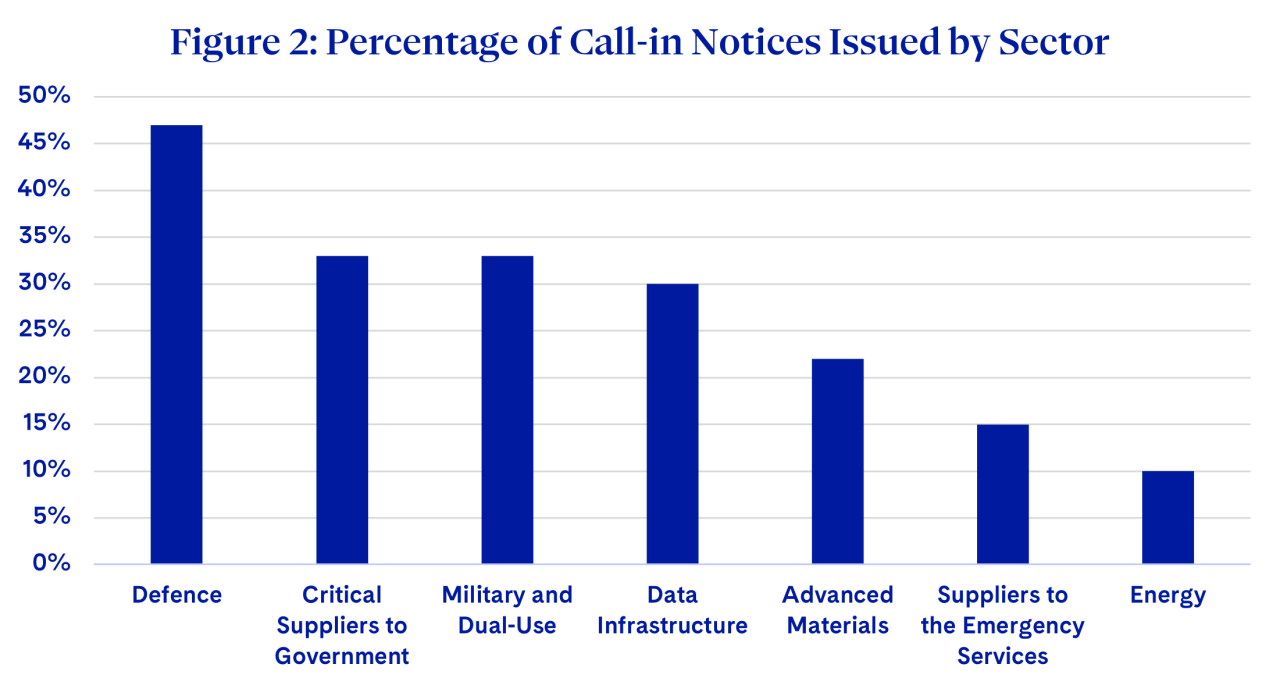
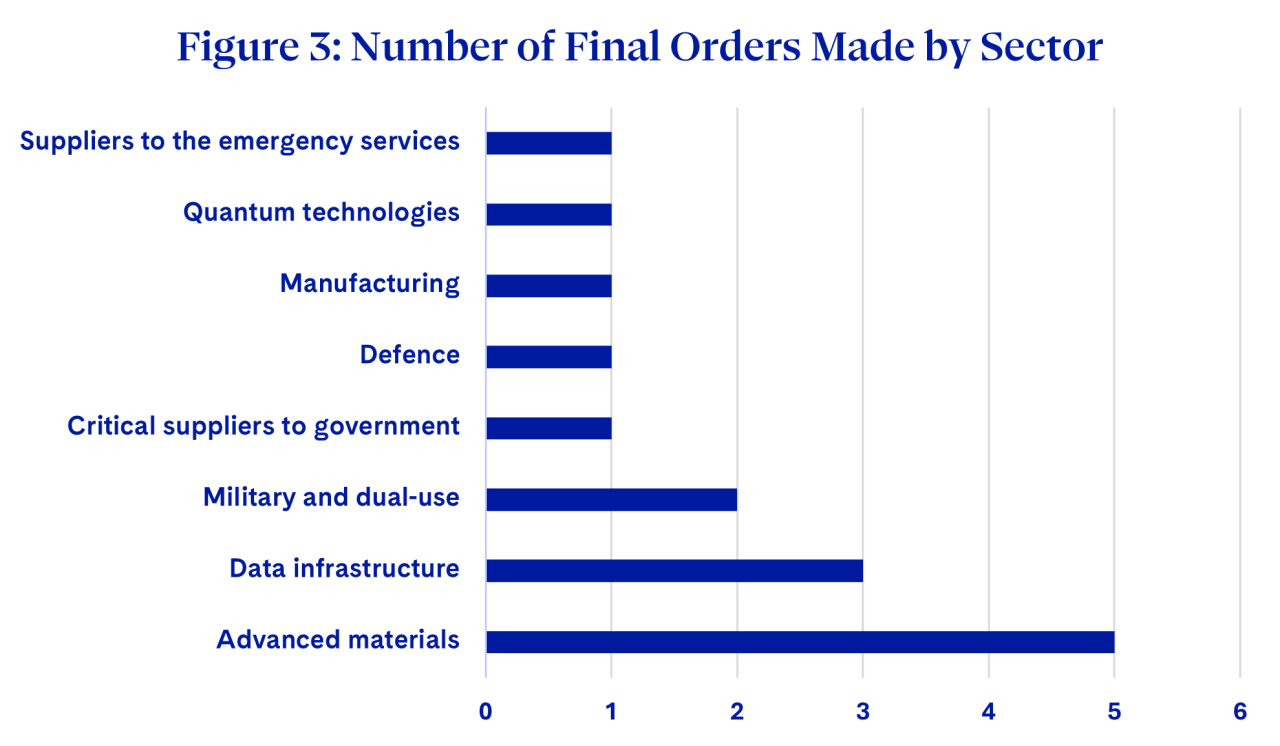
- Unsurprisingly, the defence sector again saw the highest number of notifications (58%) and the highest number of call-in notices (47%). However, in a notable shift, the largest number of Final Orders was associated with the advanced materials sector (five) and data infrastructure sector (three), not defence, which only had one Final Order in this Reporting Period.
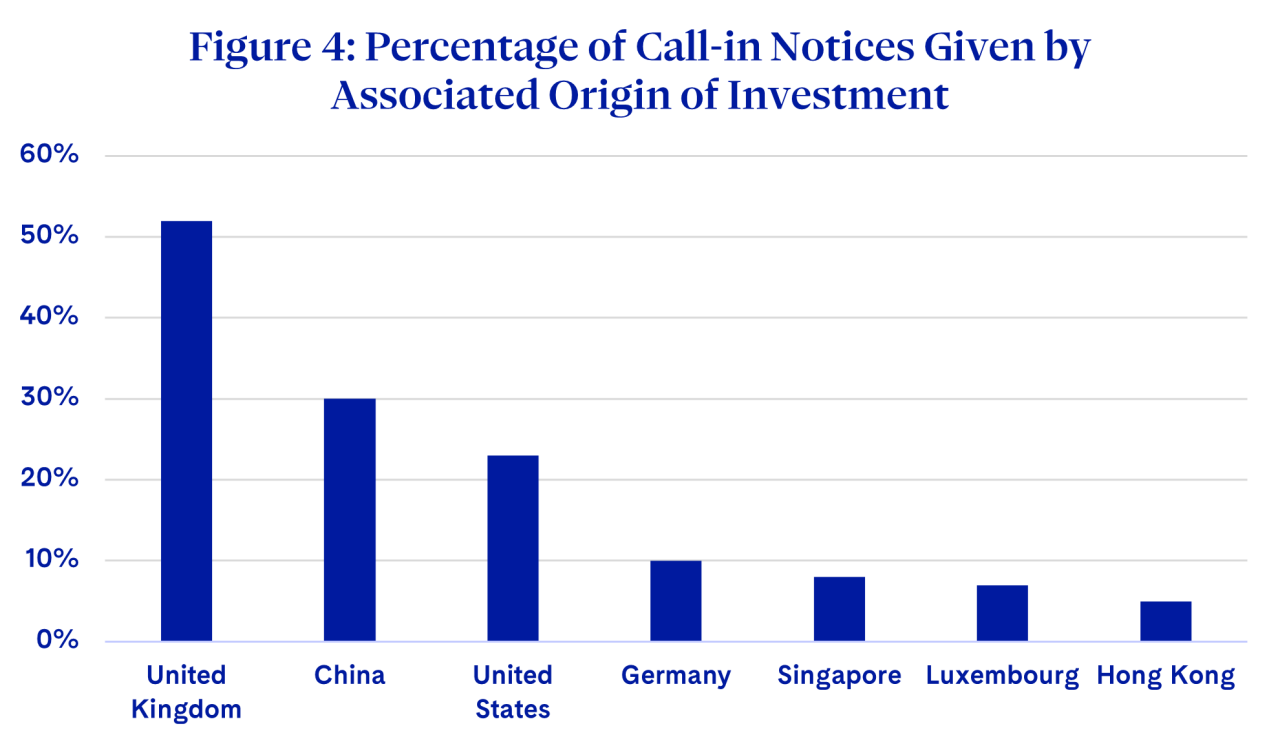
- Acquirers associated with China continued to receive significant scrutiny, accounting for 30% of called-in acquisitions despite China-related notifications representing only 2% of total notifications. UK investors accounted for the highest share of accepted notified transactions (72%) and highest share (52%) of call-ins and U.S. investors were the second highest with 28% of accepted notified transactions and 23% of call-ins.
- The Government actively monitors the market for transactions which fall foul of the mandatory notification requirement. The risk of Government intervention is real: of the 60 total transactions called in, 10% were in relation to non-notified acquisitions.
- The number of times parties withdrew from an acquisition after it being called in (“Withdrawals”) fell to just four of the 60 total transactions called in. Transactions withdrawn related mainly to investments in the advanced materials, defence and academic research and development in higher education sectors.
Overview
The Report provides useful insights into enforcement and procedural issues related to the NSI Act. It features statistics on notifications filed, call-ins and clearances, the time taken to assess notifications, the sectors associated with the acquisitions, and the countries of origin of investment. The Report, as with previous reports, lacks substantive commentary on individual decisions. While the Government publishes summaries of Final Orders made,4 the Report offers no explanation of what national security concerns drove particular call-in decisions, why certain sectors or origins of investment attract disproportionate scrutiny, or what conditions were imposed under Final Orders. Greater narrative context within the Report would materially improve its usefulness to investors and their advisers.
Notifications and Call-ins
Over the course of the Reporting Period, the Government received 1,324 notifications, up from 1,143 notifications received in the previous reporting period.5 Of these, 1,135 were mandatory and 147 were voluntary. There were also 42 retrospective validation applications in respect of notifiable transactions which had closed prior to receiving NSIA approval. Slightly under 3% of notifications were rejected, consistent with just over 3% in the previous reporting period. Notifications were mainly rejected due to withdrawal and wrongful categorisation as mandatory instead of voluntary or vice versa. Incorrect categorisation continues to cause delays, and parties should ensure accurate classifications before submitting notifications.
Of the 1,220 notifications reviewed, only 54 (4.4%) were called in for further scrutiny. This is consistent with the previous reporting period where 49 acquisitions were called in (4.5% of all reviewed notifications). This continues the trend, established since the NSIA entered into force, that only a small proportion of transactions raises potential national security concerns.
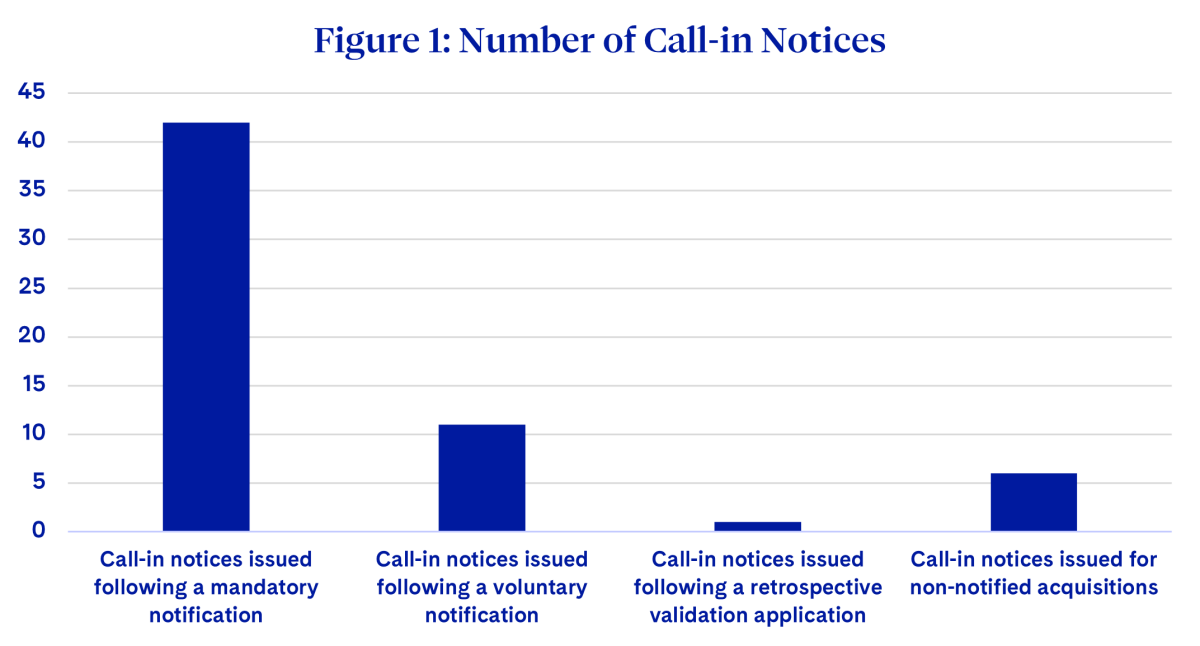
Investors should also note that six call-in notices were issued for acquisitions which had not been notified under the NSIA by the parties. This shows that the Government continues to monitor the M&A market proactively, rather than solely relying on investors to notify transactions.
The split between mandatory and voluntary call-ins shifted compared to the previous reporting period. Of the 60 total call-in notices, 42 were for mandatory notifications (70%) and 11 were for voluntary notifications (18%). By comparison, mandatory notifications accounted for 50% of call-in notices in the previous reporting period. However, voluntary notifications were still called in at a higher rate (10%) than mandatory notifications (4%), proportional to the total number of notifications made for each type. This may be explained by the fact that voluntary notifications are often made where there is some risk that a transaction might be considered to raise national security concerns.
Timing
The Government has a statutory time period of 30 working days to clear or call in a notified transaction. It took the Government a median of 29 working days to make such decisions for mandatory notifications once accepted, and a median of 30 working days for voluntary notifications. This was broadly in line with the previous reporting period. Following a call-in, the Government has 30 working days to conduct its substantive review of the transaction, which can be extended by 45 working days (known as the ‘additional period’). The Report shows that the Government used the additional period in only 18 of the 60 investigations into called-in acquisitions, which is down from 21 out of 56 investigations in the previous reporting period. This could suggest either greater confidence on the Government’s part to review transactions to its satisfaction within the ‘initial’ 30 working-day period, or investors providing more fulsome information on their notifications as parties become more familiar with the NSIA.
Statutory timelines do not necessarily give the full picture, as the Government can ‘stop the clock’ when parties respond to information or attendance notices post call-in. The days when the clock is stopped are not counted in the statutory timelines. As such, actual timelines could be longer than the statutory timelines suggest. For example, it took the Government a median of 24 statutory working days (or 47 calendar working days) to approve transactions without remedies following a call-in ("Final Notifications"), and a median of 69 statutory working days (or 97 calendar working days) to make a Final Order following a call-in.
The time to have a notification accepted or rejected must also be considered for transaction timelines, as there was a notable increase in the time taken to accept a notification. It took the Government a median of 11 working days to accept a mandatory notification and 13 working days for voluntary notifications, up from seven and eight working days, respectively, in the previous reporting period. The number of notifications pending acceptance or rejection increased to 78 notifications in the Reporting Period from 33 in the previous reporting period, possibly indicating processing delays due to increased notification volumes.
Sectors
The defence sector again accounted for the largest share of all notifications received (58%), followed by the military and dual-use sector (23%) and critical suppliers to the Government sector (20%). Figures 2 and 3 show the split of call-in notices and Final Orders across sectors. Defence also led on call-ins, accounting for 47% of the 60 call-in notices, up from 36% the previous reporting period. Notably, however, the advanced materials sector led on Final Orders with five of the nine issued, displacing defence, which had led in the previous two reporting periods. Data infrastructure (three Final Orders) and military and dual-use (two Final Orders) were the next most active sectors.
Origin of Investments
In the Reporting Period, the Government again focused on Chinese investments. Although Chinese-associated investors represented a small proportion of overall notifications, 30% of called-in acquisitions were associated with China (down slightly from 32% in the previous reporting period).
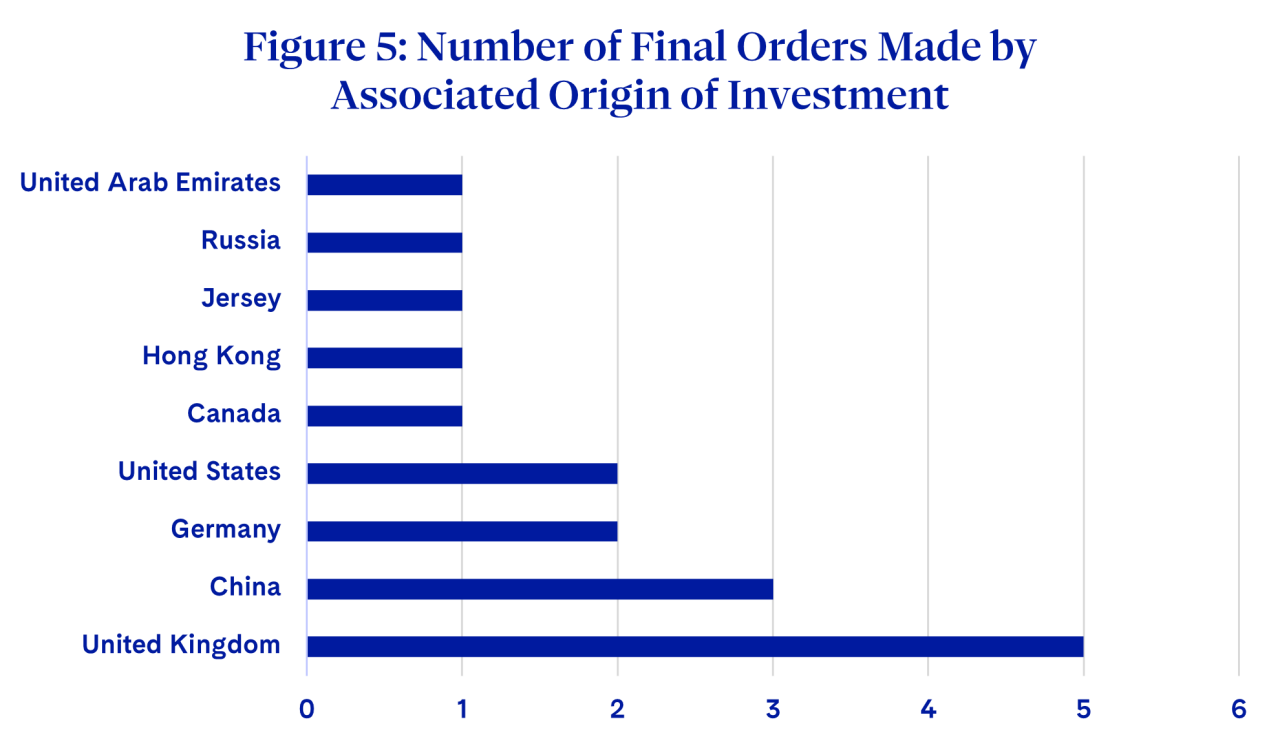
Of the nine Final Orders issued in the Reporting Period, three related to acquisitions by investors associated with China, a notable decrease from seven in the previous reporting period. The UK remained the origin of investment most associated with Final Orders, accounting for five of the nine, which is in line with the previous reporting period where it accounted for 11 of 17 Final Orders.
Withdrawals
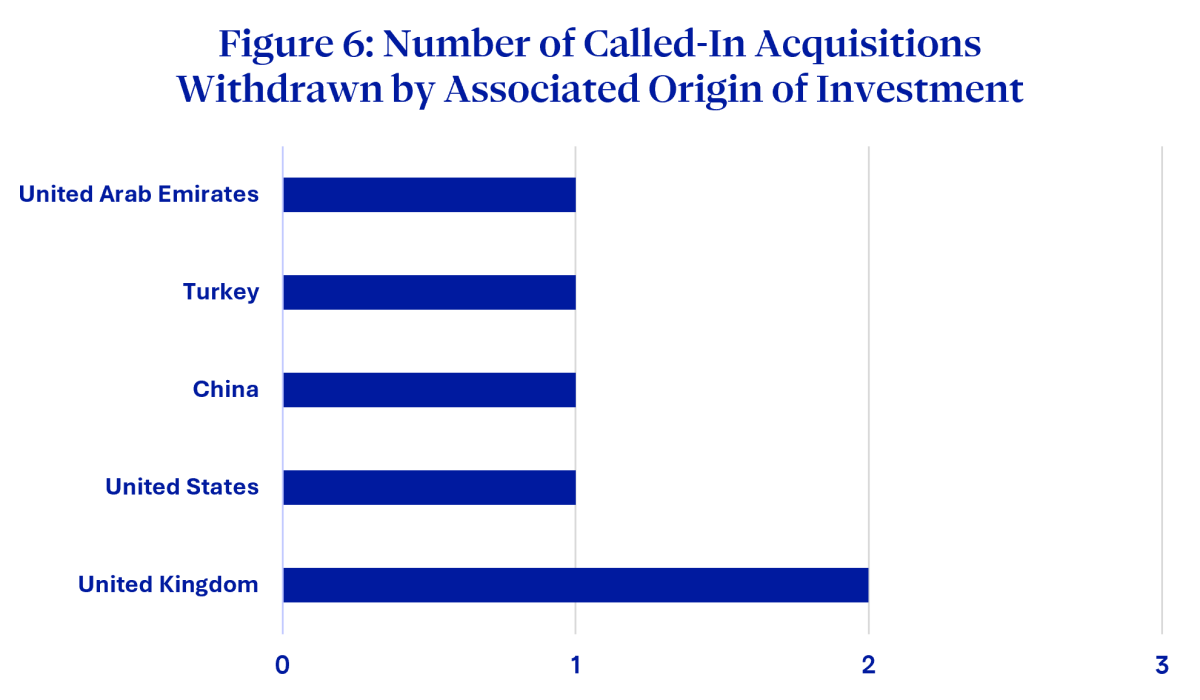
Parties withdrew a smaller number of transactions called in by the Government in the Reporting Period. Out of 60 called in, only four were withdrawn (compared with five in the previous reporting period). Two followed mandatory notifications and two followed voluntary notifications. The largest number of withdrawals related to the defence, advanced materials, and academic research and development in higher education sectors (two withdrawals each). The origin of investment associated with the most withdrawals was UK, with two withdrawals. Investors associated with China, Turkey, the UAE and the United States each accounted for one withdrawal.
Final Notifications and Final Orders
Excluding the four withdrawn transactions, 40 of the remaining called-in acquisitions were cleared by the Government without remedies (Final Notifications). Nine transactions were issued Final Orders.6 Of those nine Final Orders, eight were cleared subject to remedies and only one was blocked on national security grounds.7 The number of Final Orders fell sharply from the previous reporting period (17 Final Orders). This decline could be due to the specific transactions reviewed, or it may reflect a more targeted approach to interventions by the Government.
Looking Ahead
The Government continues to scrutinise a large number of transactions for national security concerns, but the proportion of transactions which actually raised any concerns in the Reporting Period was again very small. Transactions are reviewed within the statutory time limits and the additional period for called-in transactions is rarely used, which should provide comfort to dealmakers. Furthermore, there were fewer call-in notices proportional to the number of acquisitions reviewed and fewer Final Orders than issued in the previous reporting period. However, the increase in total notifications, up 16% from the previous reporting period, has introduced some administrative pressure, as evidenced by the increased time to accept notifications.
With over 3,900 transactions reviewed since its inception, the Government is deepening its understanding of national security risks, including the type of transactions and sectors that are likely to raise concerns. Aspects of these learnings will be reflected in its update of the 17 sectors.8 While this requires passing legislation that is yet to be introduced, it is envisioned that these proposed changes will exempt certain acquisitions from mandatory notification, clarify the scope of eight of the 17 sectors, and introduce new standalone sectors for water, semiconductors and critical minerals (with the latter two being carved out from existing sectors). These clarificatory changes will be welcomed by investors and advisers alike.
Contributors
The authors would like to thank Trainee Solicitor Neil Jones for his contributions to this OnPoint.
Footnotes
1 In the Report, the decision-maker is referred to as the Government, while the Investment Security Unit (“ISU”) administers the operation of the NSI Act. For the purposes of this OnPoint, references to ‘the Government’ include both the decision-maker and the ISU.
2 The Report is available here. Figures 1-6 in this article are copied from the Report.
3 Final orders can have a range of effects, including blocking or unwinding the acquisition, or providing conditional clearance subject to remedies.
4 See here.
5 For the report covering the previous reporting period, see here.
6 The numbers do not add up to the 60 called-in transactions because some of the transactions called in during the Reporting Period have not yet received a final decision, and some Final Orders and Final Notifications issued in the Reporting Period relate to notifications made during the previous reporting period.
7 See here.
8 See Government response to consultation, March 2026, available here.
Related Professionals


Related Services

Subscribe to Dechert Updates