
Legal and Regulatory Framework

Key Takeaways
- In the U.S., the legal and regulatory framework for investment funds that invest in private credit has been shaped by the U.S. Investment Company Act of 1940 (1940 Act) into two distinct spheres:
- funds that can be offered to retail investors and are thus subject to substantive regulation under the 1940 Act (regulated funds), and
- funds that can only be offered to investors who meet certain minimum financial thresholds or demonstrate sufficient knowledge and experience and are thus exempt from regulation under the 1940 Act (private funds).
- In Europe, the legal and regulatory framework for alternative investment funds that originate loans has been shaped by AIFMD 2.0 (in effect April 16, 2026) into two distinct categories:
- funds whose investment strategy is mainly to originate loans, or whose originated loans represent at least 50% of NAV, are subject to the full harmonized regime applicable to loan-originating funds (LOFs), including leverage caps, concentration limits, risk retention requirements and a prohibition on originate-to-distribute strategies; and
- funds that originate loans but fall below that threshold remain subject only to the general loan origination obligations introduced by AIFMD 2.0, without the full LOF-specific regime applying.
Private credit market growth and regulation in the U.S. and Europe reflect shared origins but distinct trajectories. The U.S. developed a wide range of scalable private credit fund structures earlier, while Europe gradually advanced through harmonization and cross-border coordination. The European Union’s implementation of AIFMD 2.0 marks a significant transition toward a more unified, prescriptive, and asset-class-specific regulatory framework. Because the UK Financial Conduct Authority confirmed that the UK will not implement AIFMD 2.0, managers operating cross-border between the UK and the EU will continue to use EU based fund structures (such as Luxembourg or Irish funds).
US Legal and Regulatory Framework
The U.S. regulatory framework for investment funds is rooted in the creation of the Securities and Exchange Commission (SEC) in 1934 and the subsequent enactment of the Investment Company Act of 1940 (1940 Act). The 1940 Act regulates companies that primarily invest in the securities of other entities and applies to mutual funds, registered closed-end funds (CEFs) and other investment vehicles unless an exemption from regulation under the 1940 Act is available. The statute provides key investor protections, including limits on fund leverage, prohibitions on transactions with affiliates of the fund, and certain fund governance requirements.
Two primary exemptions, Sections 3(c)(7) and 3(c)(1), form the foundation of the private fund industry. By limiting the number or qualifications of investors, these exemptions allow private funds, including hedge funds, private equity funds, venture capital funds, and private credit funds, to operate outside of the 1940 Act regulated fund framework.
Over time, Congress and the SEC have expanded the range of regulated fund structures available to private credit managers. In 1980, Congress amended the 1940 Act to create business development companies (BDCs), a specialized category of closed-end funds that provide greater regulatory flexibility, including the use of higher leverage than CEFs. In 1993, the SEC adopted Rule 23c-3 under the 1940 Act, establishing the interval fund structure, which is a specialized type of CEF or BDC that can hold illiquid assets while offering shareholders periodic liquidity through mandated periodic repurchase offers.
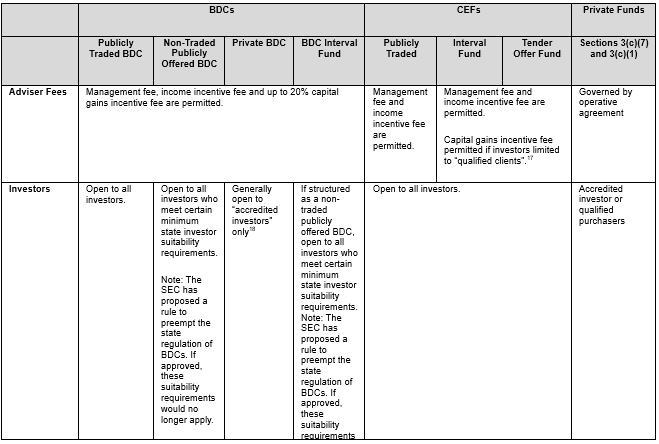
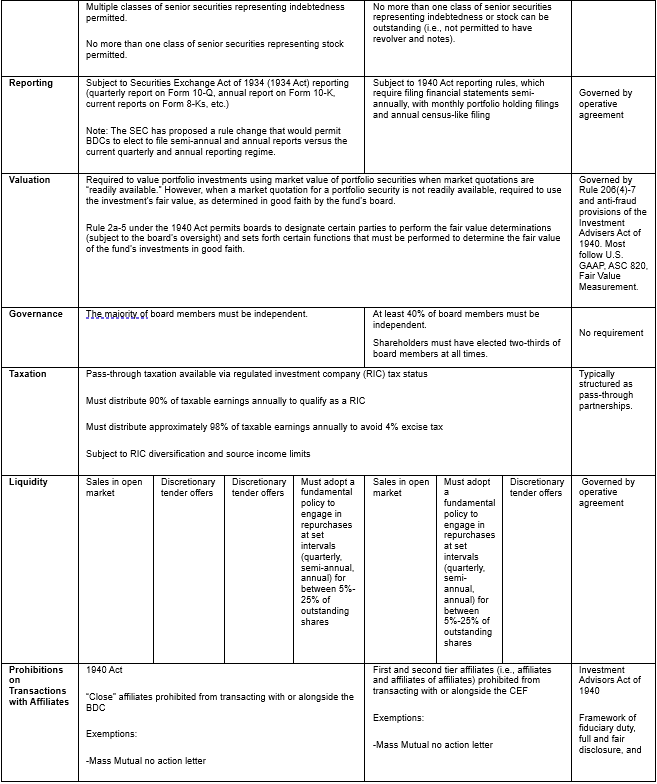
Today, private credit managers can access capital through several regulated and private fund structures, each offering a different balance of liquidity, leverage, distribution, and reporting requirements. The principal regulated structures are summarized below, with a comparison of key regulatory attributes provided in the Appendix.
Main Regulated Fund Structures for Private Credit
BDCs
BDCs occupy a unique position within the U.S. fund landscape, combining characteristics of both operating companies and private investment funds. Unlike CEFs, BDCs are required to invest at least 70% of their assets in U.S. private operating companies or U.S. public operating companies with less than a US$250 million market capitalization (the “Good BDC Asset Requirement”). They also benefit from a regulatory framework that permits them to incur higher leverage to finance their investment operations than CEFs.
BDCs can be structured in different ways:
Publicly Traded BDC – Publicly traded BDCs list shares on a national securities exchange like the New York Stock Exchange (NYSE) or Nasdaq. The vehicle may become public through an initial public offering (IPO) or a direct listing of its shares after operating as a non-traded publicly offered BDC or private BDC for a period of time. Shares may trade at a discount or premium to NAV.
Non-Traded Publicly Offered BDC – Non-traded publicly offered BDCs raise capital through continuous public offerings registered under the Securities Act of 1933 but do not list shares on a securities exchange. These BDCs typically conduct periodic, discretionary tender offers allowing shareholders to redeem shares at or near NAV.
Some non-traded BDCs pursue an eventual liquidity event, such as an exchange listing, a merger, or an asset sale. Others operate as perpetual-life BDCs, continuously raising capital and providing liquidity through periodic discretionary tender offers.
Private BDC – Private BDCs raise capital through private placements rather than public offerings. These vehicles are typically available only to institutional and accredited investors and may be structured either as traditional drawdown funds, with capital commitments, periodic capital calls, an investment period, and a wind-down period, or as perpetual-life vehicles with ongoing fundraising and tender offer repurchase mechanics similar to non-traded BDCs.
CEFs
CEFs offer another regulated framework for private credit strategies. While they share many characteristics with BDCs, they are subject to stricter leverage limitations but more flexible investment mandates than BDCs (i.e., the Good BDC Asset Requirement).
Publicly Traded CEF – Publicly traded CEFs list shares on an exchange like the NYSE or the Nasdaq. They may become public in ways similar to those of BDCs described above. Shares may trade at a discount or premium to NAV.
Interval Fund – Interval funds, which have traditionally been structured as a CEF but can be structured as a BDC, must make periodic repurchase offers, typically quarterly, for 5% to 25% of outstanding shares at NAV, pursuant to a shareholder-approved fundamental policy under Rule 23c-3 of the 1940 Act. After adoption, the fundamental policy can only be changed with the approval of the interval fund’s shareholders. Interval funds generally are offered on a continuous basis (as frequently as daily) at NAV.
Tender Offer Fund – CEFs structured as tender offer funds also provide periodic liquidity but enjoy greater flexibility than interval funds. Rather than operating under a fixed repurchase schedule, they conduct discretionary tender offers. Fund boards determine the timing, size, and frequency of these repurchase programs, allowing managers to more closely align liquidity events with portfolio cash flows and investment opportunities. Shares are generally offered continuously at NAV.
European Legal and Regulatory Framework
Unlike the United States, where private credit developed within a relatively unified regulatory system, the European market evolved across multiple jurisdictions with distinct legal traditions and supervisory regimes. Early efforts to create a more integrated investment market focused on cross-border fund distribution and investor protection through initiatives such as the Undertakings for Collective Investment in Transferable Securities (UCITS) framework and the Markets in Financial Instruments Directive (MiFID).
A more comprehensive regulatory framework for alternative investment funds (AIF) emerged with the implementation of the Alternative Investment Managers Directive (AIFMD) in 2013. AIFMD established a common supervisory regime for alternative investment fund managers (AIFMs), introduced the European marketing passport for AIFs, and created baseline requirements for governance, risk management, valuation, and regulatory reporting. While the directive significantly expanded harmonization, loan origination by AIFs remained largely governed by national rules, which either did not allow for loan origination by funds at all or the relevant rules were not sufficiently clear or respected in other member states of the EEA.
Loan origination by alternative investment funds in Europe
Prior to AIFMD 2.0, there was no unified European framework governing direct lending by investment funds. In many jurisdictions, lending was viewed as a regulated banking activity that could only be conducted by licensed credit institutions. As a result, private credit managers faced a fragmented regulatory landscape, with permissible fund structures and lending activities varying significantly across member states.
European policymakers gradually expanded the role of investment funds in private lending through targeted legislative initiatives. The European Venture Capital Fund (EuVECA) regime and the European Long-Term Investment Fund (ELTIF) framework each permitted certain lending activities, providing early pathways for non-bank credit formation.
A pivotal step occurred in 2016 when the European Securities and Markets Authority (ESMA) published its opinion on a European framework for loan origination by funds. ESMA acknowledged the increasing importance of non-bank lenders while emphasizing the need for safeguards to manage systemic risk, liquidity mismatches, conflicts of interest, and investor protection concerns.
These efforts culminated in the adoption of AIFMD 2.0, which introduced the first harmonized European regulatory framework specifically governing loan-origination activities conducted by alternative investment funds. The revised directive became effective across the European Economic Area (EEA) on April 16, 2026, subject to certain transitional arrangements for existing funds and previously originated loans.
Loan-originating funds (LOF) under AIFMD 2.0
From April 2026, any AIF that intends to “originate loans” within the meaning of AIFMD 2.01 must assess whether it qualifies as a “loan-originating fund” or “LOF”.
Under AIFMD 2.0, a “loan-originating AIF” means an AIF:
- (i) whose investment strategy is mainly to originate loans; or
- (ii) whose originated loans have a notional value that represents at least 50% of its NAV.
ESMA was mandated under AIFMD 2.0 to prepare detailed regulatory technical standards (RTS) for LOFs that wish to maintain an open-ended structure (the OE LOF RTS). In October 2025, ESMA published its final report2 on the OE LOF RTS.3
Overview of the new rules applicable to the activity of “originating a loan”
AIFMD 2.0 imposes new obligations on AIFMs that manage AIFs engaging in any loan origination activity. The key requirements are set out below.
Leverage Caps
Calculated using the commitment method under AIFMD4, the following leverage caps apply:
- (i) open-ended LOFs may be leveraged up to 175% of the NAV; and
- (ii) closed-ended LOFs may be leveraged up to 300% of the NAV.
For AIFs, leverage is generally defined as an AIFs’ exposure, and short-term borrowing covered by undrawn commitments may be excluded. For LOFs, however, leverage must be calculated using only the commitment method, and short-term borrowing cannot be excluded. This is appropriate for risk-limitation purposes: the commitment method accounts for netting and hedging and typically produces a lower leverage figure due to risk mitigation, making it a more conservative measure for LOFs.
Diversification requirements and concentration limits
To address the risk of interconnectedness among AIFs that originate loans and other market participants, AIFMs of those AIFs must diversify their risk and comply with certain exposure limits. An AIF may not originate loans (including through an SPV) to any single AIF, UCITS, or other financial undertaking with a notional value exceeding 20% of the AIFs’ capital (its investible commitments after deducting all fees, charges and expenses borne directly or indirectly by investors). A ramp-up period of up to 24 months is permitted (extendable by a further 12 months). Certain carveouts apply to the 20% limit, such as for asset sales to meet redemptions or as part of the AIF's liquidation. The limit may also be temporarily suspended for up to 12 months when the AIF's capital is increased or reduced5.
Although AIFMD 2.0 does not expressly address the point, market participants in Luxembourg generally take the view that the Luxembourg implementing measures permit an exemption from the 20% limit where the relevant AIF is a feeder fund feeding into a master fund and provides a shareholder loan to the master (which may be advantageous from a tax perspective).
Conflicts of interest with regard to lending
To limit conflicts of interest, AIFMs and their staff must not receive loans from any AIF they manage. The same prohibition applies to the AIF's depositary and the depositary's delegates, the AIFM's delegates and their staff, and entities within the same group as the AIFM.
Risk management, policies, procedures and processes for AIFMs managing AIFs that grant loans:
In addition to the existing requirement for AIFMs to review their risk management systems at appropriate frequency and at least annually, AIFMs managing AIFs that engage in loan origination must implement effective policies, procedures and processes for: (i) the granting of loans; and (ii) assessing credit risk and administering and monitoring their credit portfolios. These policies, procedures, and processes must be proportionate to the scale of loan origination, kept up to date, and reviewed at least once a year.
Fees and expenses disclosures
Under Article 23, LOFs must now regularly report the exact composition of the loan origination portfolio to investors.
Expanded data points covering staffing, delegation metrics, and liquidity data must be sent to regulators. This reporting requirement has been deferred to 16 April 2027.
Access to loans originated by AIFs across the EU - exception for loans to consumers
EEA Member States may restrict the origination of consumer loans or require AIFs that grant such loans to meet additional national requirements. This discretion reflects Member States' interest in consumer protection while preserving access to this source of capital for the market. Germany and Luxembourg have implemented such a restriction on consumer lending, although Luxembourg does not restrict Luxembourg-based AIFs from holding consumer loan portfolios.
Some market participants have argued that AIFMD 2.0’s treatment of consumer lending implies that loan origination to professional borrowers should be permitted and should no longer be prohibited under national banking rules. Under this interpretation, LOF-originating loans would not require a banking license under the relevant EEA Member State's rules. However, national legislators have generally not adopted this view, and in certain EEA Member States, lenders, including LOFs, may still be required to hold a banking license.
Shareholder loans
AIFMD 2.0 applies to AIFMs managing AIFs that originate loans directly, and to those that do so indirectly through an SPV. Shareholder loans are treated as loans for all purposes under AIFMD 2.0 and fall within its scope. Notably, an AIF whose investment policy does not include loan origination may nonetheless qualify as a LOF if it holds assets through SPVs — particularly in a two-tier downstream structure — and those SPVs are financed by way of shareholder loans.
Shareholder loans, however, benefit from an exemption from calculation towards the leverage caps referenced above.
No “originate to distribute”
AIFMs are expressly prohibited from managing an AIF that originates loans with the sole purpose of selling them to third parties. The relevant AIF's focus must be on granting loans as part of its investment strategy for the benefit of investors, subject to regulatory constraints. This prohibition applies to loans originated directly by the AIF and indirectly, for example through an SPV.
Risk retention requirements
To disincentivize reckless lending, an AIF must retain at least 5% of the notional value of any loan it originates and subsequently sells. The AIF must retain that 5% interest until the loan matures, or for at least eight years if the loan term exceeds eight years. Derogations from the risk retention requirement include:
- where the AIFM starts to sell assets of the AIF to redeem units or shares as part of the liquidation of the AIF;
- where the disposal is necessary for compliance with sanctions or with product requirements;
- where the sale of the loan is necessary to enable the AIFM to implement the investment strategy of the AIF it manages, in the best interests of the AIF's investors; and
- where the quality of the loan deteriorates, provided that the purchaser is informed of such deterioration.
Applicability of liquidity management tools
Open-ended AIFS and UCITS are now subject to specific liquidity management rules (LMTs) to ensure AIFs can meet redemption requests and other obligations. This focus on liquidity stems in part from the 2008/2009 global financial crisis, which led the European legislator to make investor protection, market stability, transparency and risk management central concerns of AIFMD. The original AIFMD text set out broad general principles, reflecting the wide variety of AIFs subject to the directive. AIFMD 2.0 built on that approach, including by regulating the use of LMTs, and confirming that the primary responsibility for choosing an appropriate liquidity management system remains with the AIFM.6
All open-ended AIFs7 must incorporate at least two of the nine LMTs listed below. The suspension of subscriptions, repurchases and redemptions (item (1) below) may not be counted as one of those two mandatory tools. The LMTs are:
- (1) suspension of subscriptions, repurchases and redemptions of units,
- (2) redemption gate,
- (3) extension of the notice period,
- (4) redemption fee8,
- (5) swing pricing,
- (6) dual pricing,
- (7) anti-dilution levy,
- (8) the redemption in kind whereby AIFMD 2.0 does not allow this mechanism to be used for retail investors9, and
- (9) the creation of side pockets10.
Fair treatment of investors must be respected when applying LMTs11.
AIFMD 2.0 distinguishes between LMTs used in the ordinary course of business and those functioning as crisis management tools, treating suspensions and side pockets as the latter. Consistent with IOSCO and FSB principles, redemption gating and notice period extensions are qualitative measures, while the remaining ordinary course12 tools are quantitative. While there is no legislative requirement to use a quantitative measure, AIFMs structuring and managing an open-ended AIF would nonetheless be expected to select anti-dilution measures to ensure fair treatment of investors.
LMTs should be appropriate to the AIF’s investment strategy, liquidity profile, and redemption policy. AIFMs should activate those tools when necessary to safeguard investor’s interests.
AIFMD 2.0 tasked ESMA to develop guidelines13 considering the diversity of investment strategies and underlying assets of AIFs. It specifically notes that those standards are not intended to restrict AIFMs' ability to use any appropriate LMT across all asset classes, jurisdictions, and market conditions.
Open-Ended or Closed-Ended
LOFs are in principle required to be closed-ended. However, an AIFM14 may maintain an open-ended15 LOF if it can demonstrate to the competent authorities of its home EEA16 Member State that the fund's liquidity risk management system aligns with its investment strategy and redemption policy, minimizes liquidity mismatches, ensures fair treatment of investors, and remains subject to home-state supervision. Each competent authority will determine how that requirement must be evidenced, and how the supervisory requirement will apply in practice.
Conclusion
The evolution of private credit markets in the U.S. and Europe reflects both the growing importance of non-bank lending and the distinct regulatory choices each market has made in response. In the U.S., the framework has developed around the 1940 Act’s distinction between regulated funds and private funds, allowing private credit managers to serve both institutional and, through 1940 Act regulated fund structures such as BDCs and CEFs, a retail investor base. In Europe, the development of AIFMD 2.0 marks a significant step toward harmonizing AIF loan origination, with new rules focused on leverage, concentration, liquidity management, risk retention, and investor protection.
As private credit continues to expand across jurisdictions and investor segments, regulatory frameworks will remain central to the market’s long-term resilience. The ability of managers to navigate these evolving requirements, while maintaining robust valuation processes, clear disclosure, and sound governance, will be critical to sustaining investor confidence and supporting the continued growth of private credit in both the U.S. and Europe.
Appendix
Key Regulatory and Other Features of the Main Types of Private Credit Funds in the U.S.


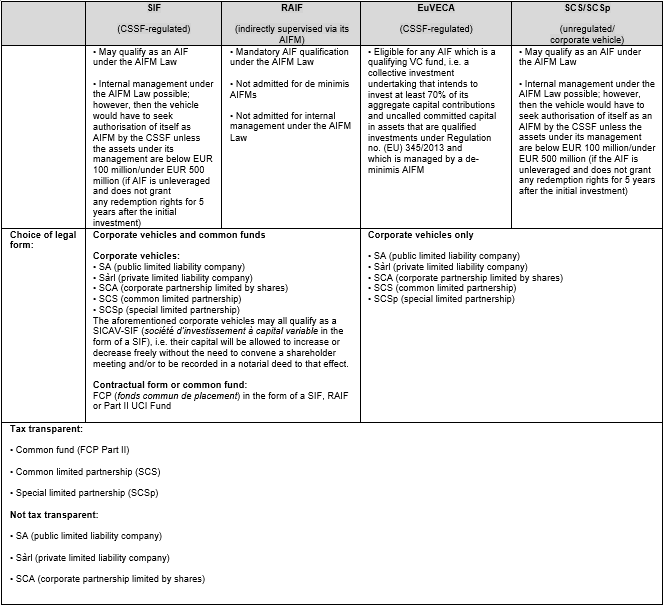
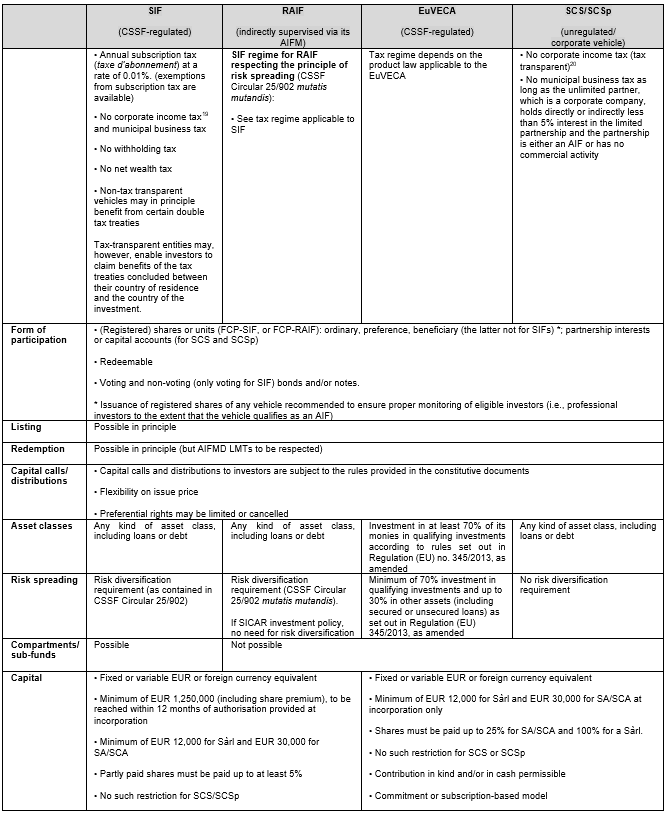
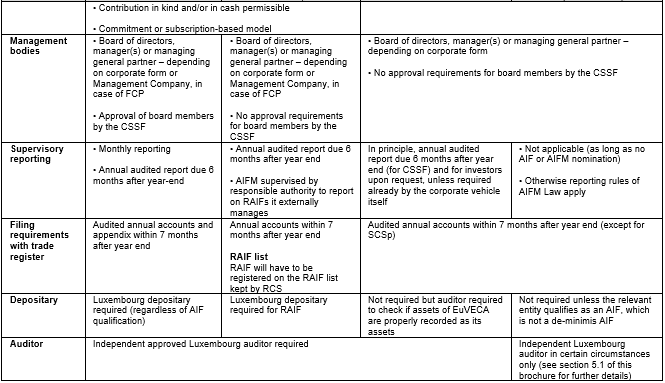
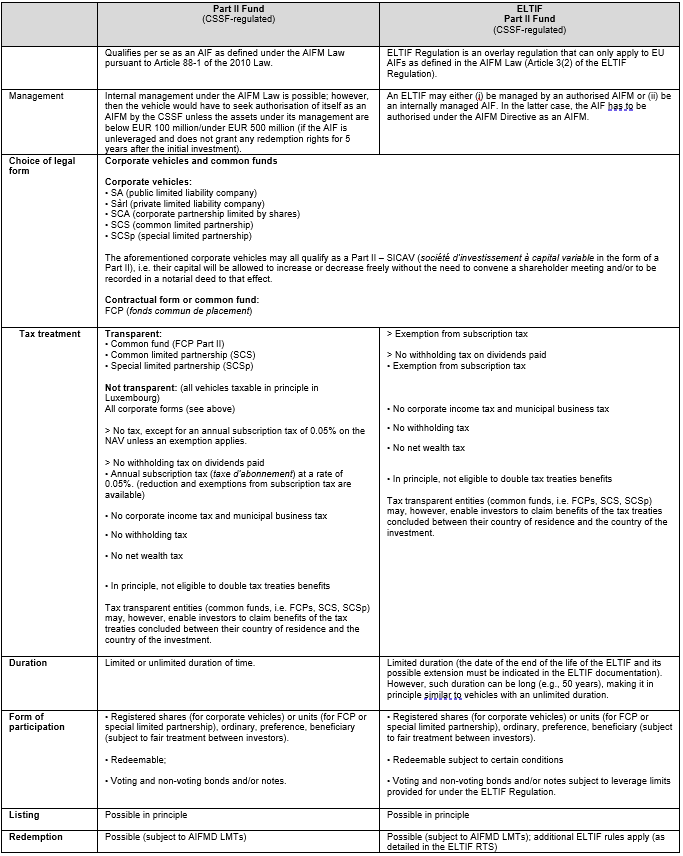
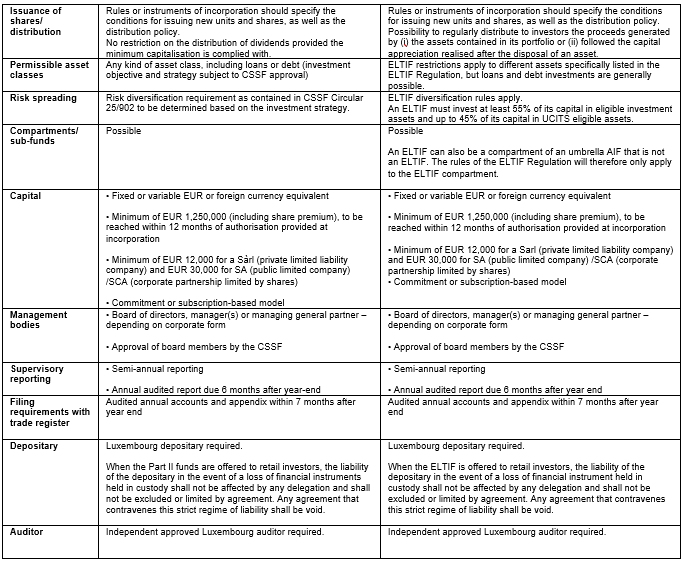
Key Regulatory and Other Features of the Main Types of Private Credit Funds in the EU (Luxembourg).
AIF (typically used for non-retail investors)
The following shows the difference between AIF qualifying as a Part II Fund or an ELTIF-qualified Part II fund dedicated to retail investors.
[1] “Qualified client” is a client has at least $1,000,000 under management the investment adviser to the CEF interval fund/CEF tender offer fund; or the investment adviser to the CEF interval fund/CEF tender reasonably believes such client has a net worth (together with assets held jointly with a spouse) of more than $2,100,000.
[2] “Accredited investor” is (A) an individual with annual income over $200,000 (or $300,000 with a spouse) for the past two years with the expectation of maintaining that income, or a net worth exceeding $1 million (individually or jointly with a spouse), excluding their primary residence or (B) an entity with $5 million in assets.
[3] For SIF established as a tax transparent entity, anti-hybrid mismatch rules need however to be monitored (see section “2015 OECD BEPS Action Plan” below)
[4] Anti-hybrid mismatch rules need however to be monitored (see section “2015 OECD BEPS Action Plan” below)
Contributors
This article was co-authored by VRC:
Adrian Lowery, CFA
Managing Director
Valuation Research Corporation
Tel. No. (609) 243-7022
ALowery@ValuationResearch.com
Parag Patel
Senior Managing Director, Business Development
Valuation Research Corporation
Tel. No. (917) 338-5618
ParagPatel@ValuationResearch.com
Daniel Turi, CFA
Managing Director
Valuation Research Corporation
Tel. No. +44 7388 087018
DTuri@ValuationResearch.com
About VRC
VRC provides independent valuation insight across private equity, private credit, and hybrid structures – offering trusted opinions to meet governance, reporting and regulatory requirements. Learn more.
Footnotes
- Technically, as of that date, the requirement is to be found in the relevant national measures implementing the AIFMD 2.0 of a given EEA Member State. For simplification purposes, we will continue to refer to AIFMD 2.0.
- Please refer to the final report on the RTS: https://www.esma.europa.eu/sites/default/files/2025-10/ESMA34-6714043361345_Final_Report_on_the_Draft_Regulatory_Technical_Standards_on_open-ended_loanoriginating_AIFs_under_the_AIFMD.pdf
- There is some degree of uncertainty following the letter from the European Commission (the Commission) of 1 October 2025 to the European supervisory bodies announcing that it will not adopt non-essential Level 2 acts (i.e., certain RTS) before 1 October 2027 at the earliest, due to the high volume of Level 2 empowerments and also in light of the Commission's simplification agenda. The press release accompanying ESMA's publication of the OE LOF RTS expressly states that the OE LOF RTS have been submitted to the Commission for adoption but that ESMA draws stakeholders' attention to the fact that the Commission includes these OE LOF RTS on the list of the non-essential Level 2 acts that the Commission will not adopt before 1 October 2027 at the earliest.
- cf. article 8 of regulation (EU) 231/2013 supplementing Directive 2011/61/EU with regard to exemptions, general operating conditions, depositaries, leverage, transparency and supervision.
- To the extent the relevant AIF is structured in a way that its capital requires an additional step increase or reduce capital as opposed to variable capital structures common in Luxembourg and France, i.e. société d’investissement à capital variable, SICAV.
- Recital 33 of AIFMD 2.0.
- Please see above footnote 14.
- This means a fee within a predetermined range that takes account of the cost of liquidity that is paid to the AIF by the redeeming investor.
- The European legislator is putting a range of protective measures in place for retail investors. This fits well in the Capital Market Strategy including the Retail Investor Strategy proposal. The non-European reader should be aware that "retail investor" is a very broad category and includes smaller institutions, and it generally captures high net worth individuals who do not invest under a discretionary mandate of a bank or an investment firm. A retail investor under AIFMD is an investor that is not a professional investor.
- This means separating certain assets, whose economic or legal features have changed significantly or become uncertain due to exceptional circumstances, from the other assets of the AIF.
- Recital 31.
- See the distinction made on the notification of activation.
- https://www.esma.europa.eu/sites/default/files/2026-03/ESMA34-671404336-1364_Guidelines_on_liquidity_management_tools_of_UCITS_and_open-ended_AIFs.pdf
- As defined by AIFMD.
- European rules have a very broad concept of an open-ended AIF with a three-tier requirement, that is, an AIF is open-ended if redemption or repurchase requests are (1) possible on request of the investor, (ii) accepted before the liquidation phase or wind-down of the AIF, and (iii) satisfied out of the assets of the AIF. EU laws do not consider the concept of “semi-liquid” or “semi-closed” funds—the categorization is purely binary, which can lead to issues for products that do not sit neatly in one of the categories. The definition of an open-ended AIF is deliberately broad. The risks connected with an open-ended product could be present even if the AIF would allow only a small number of investors the benefits of early redemptions (for example, granting the right to a single investor in a side letter). However, regulation (EU) 964/2014 clarifies that distributions by an AIF, including the distribution that has been authorized by a resolution of the investors, is not be considered as a redemption or repurchase request for the purpose of the definition, that is, would not lead to the AIF being considered as open-ended. Secondary transactions are similarly excluded.
- EEA being the European Economic Area, comprising every EU Member State, Iceland, Norway and Liechtenstein.