
Deal execution considerations for sponsors and strategics as federal transparency efforts develop alongside state-by-state transaction review laws
Key Takeaways:
- Federal regulatory healthcare-transparency expectations are expanding. CMS sought comments on proposed ownership-related disclosure expansions.
- State healthcare transaction review remains a growing patchwork. More states are adopting healthcare-specific notice and review regimes, with real implications for deal timing and process even where a transaction does not trigger federal HSR.
- Why it matters for healthcare sponsors and strategics. The combined federal and state trajectory is changing how deal teams plan diligence, disclosures, and closing timelines.
Relevant Background
Policymakers at both the state and federal levels have focused increasing attention on the transparency of equity participation in healthcare – examining ownership structures, debt loads, and real estate arrangements that are often opaque under existing disclosure regimes. This scrutiny has accelerated in recent years, building on a wave of state-level laws as discussed in recent Dechert OnPoints on CPOM developments and industry-agnostic mini-HSR notice laws. Oregon’s 2025 legislation, the most restrictive to date, reflects the direction in which states are moving while federal action stalls.1 Several federal proposals discussed below would be significant if enacted, but at this time they are best viewed as monitoring items, and near-term enactment remains uncertain.
With state laws creating an inconsistent compliance burden and federal disclosure requirements still developing, federal lawmakers have introduced a series of bills that would fundamentally alter the reporting obligations – and in some cases the operating conditions – for PE-backed healthcare investment.
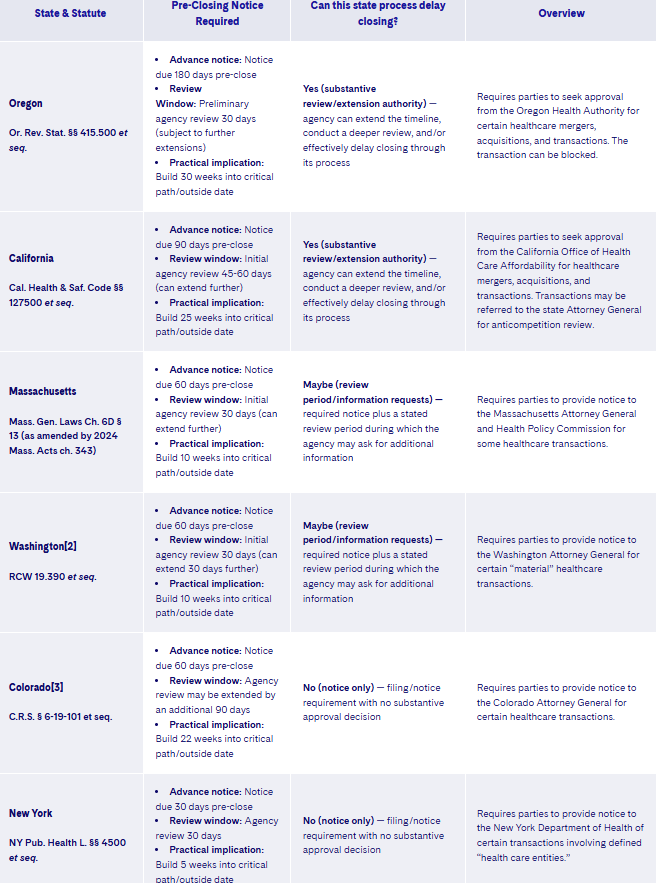
Example State “Mini-HSR” Laws
For healthcare-related transactions. Illustrative examples (not exhaustive), as of August 2026. Requirements vary by state and transaction structure.
Existing Framework and Deal Requirements
The Hart-Scott-Rodino Antitrust Improvements Act
The HSR Act establishes the only federal pre-transaction notification mechanism currently applicable to transactions above certain thresholds,4 including healthcare-related transactions. HSR filings are antitrust-focused and confidential by statute (with some exceptions related to transactions on which early termination is sought); they are not designed as a public ownership-transparency tool and do not disclose information to the public or to state regulators.
Centers for Medicare & Medicaid Services (“CMS”) Medicare Enrollment Disclosure
The November 2023 CMS final rule (effective January 2024) established expanded ownership disclosure requirements for Medicare and Medicaid providers.5 These requirements are already operative and apply across all institutional provider types.
The rule finalized the following definitions of organizational structure for purposes of ownership disclosure:
- Corporation: all shareholders with a 5% or greater direct or indirect ownership interest
- LLC: all members regardless of ownership percentage, and all managers
- Partnership: all general partners and all limited partners with a 10% or greater interest
In July 2026, CMS published a proposed rule that would significantly expand the PE and REIT disclosure regime and broaden CMS’s enrollment enforcement authority across all provider types rather than only skilled nursing facilities (SNF). CMS solicited comments (which were due August 31, 2026), and the proposal is not final.6
Federal Legislative Developments and Potential Implications for Deals
Federal legislation has been proposed in this space, but none of the proposals discussed below have been enacted as of publication and there appears to be a low probability that they will be enacted in the near term. Dechert continues to monitor developments around the following items.
Disclosure and Transparency Bills
The proposed Corporate Crimes Against Health Care Act (S. 3829) was first introduced in June 2024, reintroduced on February 11, 2026, and referred to the Senate Committee on Finance, where it has not advanced.7 It is the most comprehensive federal transparency proposal currently before Congress. The bill would require any healthcare provider receiving federal funding to submit annual reports to HHS covering mergers, acquisitions, ownership changes, debt levels, debt-to-earnings ratios, and real estate lease arrangements.
Beyond disclosure, the bill could affect both existing investments and future transactions by imposing criminal penalties on executives whose conduct results in patient harm post-transaction, authorizing compensation clawbacks going back ten years, prohibiting federal program payments to entities using assets as collateral for REIT loans, and repealing the REIT qualified dividend pass-through deduction for healthcare property.
Medicare Eligibility Restrictions
The Take Back Our Hospitals Act (S. 4085), introduced in March 2026 and referred to the Senate Committee on Finance, warrants careful attention from hospital and SNF investors specifically as it would affect permissible structures of both new transactions and existing investments.8 Any hospital or SNF owned or controlled by a “covered firm” would be ineligible to receive Medicare reimbursement. Covered firms include any private equity fund, any corporation owned or controlled by a private equity fund, and any real estate investment trust. Control is defined broadly: owning 10% or more of voting securities creates a presumptive control finding, and management agreements are captured unless limited strictly to goods or non-management services.9
Facilities already owned by a covered firm at enactment would have three years to restructure or divest. The covered firm and its affiliates would be jointly and severally liable for any penalties imposed on a non-compliant facility.
The bill has not advanced beyond referral.
Industry-Specific Developments
The American Medical Association adopted a new policy at its 2026 Annual Meeting to intensify its opposition to corporate practice of medicine arrangements.10 The policy affirms that physician practices should remain under physician ownership and governance, it opposes contractual mechanisms that allow non-licensed entities to exercise de facto control, and it explicitly targets noncompetition, nondisclosure, and non-interference clauses. While AMA policy carries no legal force and would not directly impact transaction processes or structures, it reflects the professional consensus that state legislatures and federal regulators increasingly draw on when drafting and enforcing CPOM frameworks.11
How Should PE Investors Prepare?
No federal healthcare-specific transparency law has been enacted yet, but the regulatory trajectory signals that these laws could become a key point for investors as well as lawmakers in the future. Disclosure-only bills represent a less burdensome outcome than the Medicare-eligibility restrictions proposed in more aggressive legislation, as they impose increased reporting obligations but cause no transactional delays.
Against this backdrop, investors should take the following steps to prepare for potential future reporting obligations:
- Audit ownership and control chains against definitional frameworks in pending legislation.
- Audit management service and dental service organization arrangements for provisions that could constitute de facto control under the Take Back Our Hospitals Act’s broad control definition, which captures management agreements and any indirect direction of administrative functions or assets.
- Maintain ownership documentation that would be sufficient to respond to HHS annual reporting requirements should the Corporate Crimes Against Health Care Act advance.
- Build potential overlapping state submissions (mini-HSR and healthcare transaction notice/review filings) into the critical path from the outset.
- Add covenants in governing documents and/or subscription agreements, as well as in credit agreements requiring investors and lenders to maintain the ownership and financial documentation that current CMS rules and S. 3829’s framework would require. Build the obligation in now rather than retrofitting after enactment.
Conclusion
As both state and federal policymakers continue to press for greater visibility into private equity’s role in healthcare, the regulatory and legislative landscape is evolving rapidly. The existing federal disclosure framework – anchored today in the 2024 CMS enrollment rule – could expand materially, whether through the pending CMS proposed rule, the Corporate Crimes Against Health Care Act, or successor legislation, though there is a low probability that these will be enacted in the near term. Investors navigating this environment could expect rising baseline disclosure obligations and, in the most aggressive scenarios, constraints on Medicare eligibility that could reshape exit options and asset valuations. Dechert will continue to monitor these developments and keep investors informed as this area continues to command significant legislative attention.
Contributors
The authors wish to thank summer associates Jessica Bertolini and Jaci Ross for their contributions to this OnPoint.
Footnotes
- Jennifer Csik Hutchens & Margaret L. Hanson, “New Oregon Law Leads Nation in Restricting Healthcare Investment,” Dechert LLP (June 26, 2025), https://www.dechert.com/knowledge/onpoint/2025/6/new-oregon-law-leads-nation-in-restricting-healthcare-investment.html.
- Washington has a separate notice regime under its Uniform Antitrust Premerger Notification Act, which requires a party to any HSR-reportable transaction to submit a copy of its federal HSR filing to the Washington attorney general if such party (i) has a principal place of business within the state, (ii) directly or indirectly has annual net sales in Washington of the goods or services involved in the transaction of at least 20% of the HSR filing threshold then in effect, or (iii) is a health care provider or provider organization (as defined in RCW 19.390.020) conducting business in the state.
- Colorado also has a separate notice regime under its Uniform Antitrust Premerger Notification Act, which differs from the Washington version in that it does not have a healthcare prong. Any party to an HSR-reportable transaction is required to submit a copy of its federal HSR filing to the Colorado attorney general if such party (i) has a principal place of business within the state, or (ii) directly or indirectly has annual net sales in Colorado of the goods or services involved in the transaction of at least 20% of the HSR filing threshold then in effect.
- James A. Fishkin, Beverly J. Ang & William Kearney, “Minimum HSR Reporting Threshold Rises to US$133.9 Million; Interlocking Directorates Threshold Updated,” Dechert LLP (January 15, 2026), https://www.dechert.com/knowledge/onpoint/2026/1/minimum-hsr-reporting-threshold-rises-to-us-133-9-million--inter.html.
- Available at: https://www.federalregister.gov/documents/2023/11/17/2023-25408/medicare-and-medicaid-programs-disclosures-of-ownership-and-additional-disclosable-parties.
- Available at: https://www.govinfo.gov/content/pkg/FR-2026-07-06/pdf/2026-13602.pdf.
- Corporate Crimes Against Health Care Act, S. 3829, 119th Cong. (2026), https://www.govinfo.gov/content/pkg/BILLS-119s3829is/pdf/BILLS-119s3829is.pdf.
- Take Back Our Hospitals Act of 2026, S. 4085, 119th Cong. (2026), https://www.congress.gov/bill/119th-congress/senate-bill/4085/text/is.
- Id.
- AMA Strengthens Opposition to Corporate Practice of Medicine, Am. Med. Ass’n (last visited July 17, 2026), https://www.ama-assn.org/press-center/ama-press-releases/ama-strengthens-opposition-corporate-practice-medicine.
- Id.