DAMITT Q3 2026: Subdued Merger Enforcement Continues Alongside Shorter Reviews

October 29, 2026
DAMITT, the Dechert Antitrust Merger Investigation Timing Tracker, is the leading source of analysis for significant U.S. and EU antitrust merger investigation and litigation trends.
Key Facts
United States
- With only four significant merger investigations concluding in Q3 2026, U.S. merger enforcement remains on track for a fourth consecutive year with fewer than 20 significant merger investigations.
- No significant merger investigations resulted in a lawsuit through the end of Q3 2026, though DOJ took credit for causing the second significant merger abandonment of the year.
- Closing statements remained a prominent feature of merger enforcement under Trump II in Q3 2026, offering valuable insight into how the FTC and DOJ weigh competitive concerns against litigation risk and enforcement priorities.
- While U.S. significant merger review timelines increased modestly in Q3, the average duration of 10.1 months YTD remains on pace to reach the fastest level since 2018.
European Union
- Despite an uptick in Q3 2026 with three significant outcomes, the total of only six in year-to-date is on pace to be one of the slowest EU enforcement periods since DAMITT began tracking the data in 2011.
- The three significant investigations concluded in Q3 2026 — which included two Phase I decisions with remedies and one Phase II withdrawal — fell short of the long-run average of 4.4 investigations per quarter recorded in the EU since 2011, continuing a downward trend over the past several years.
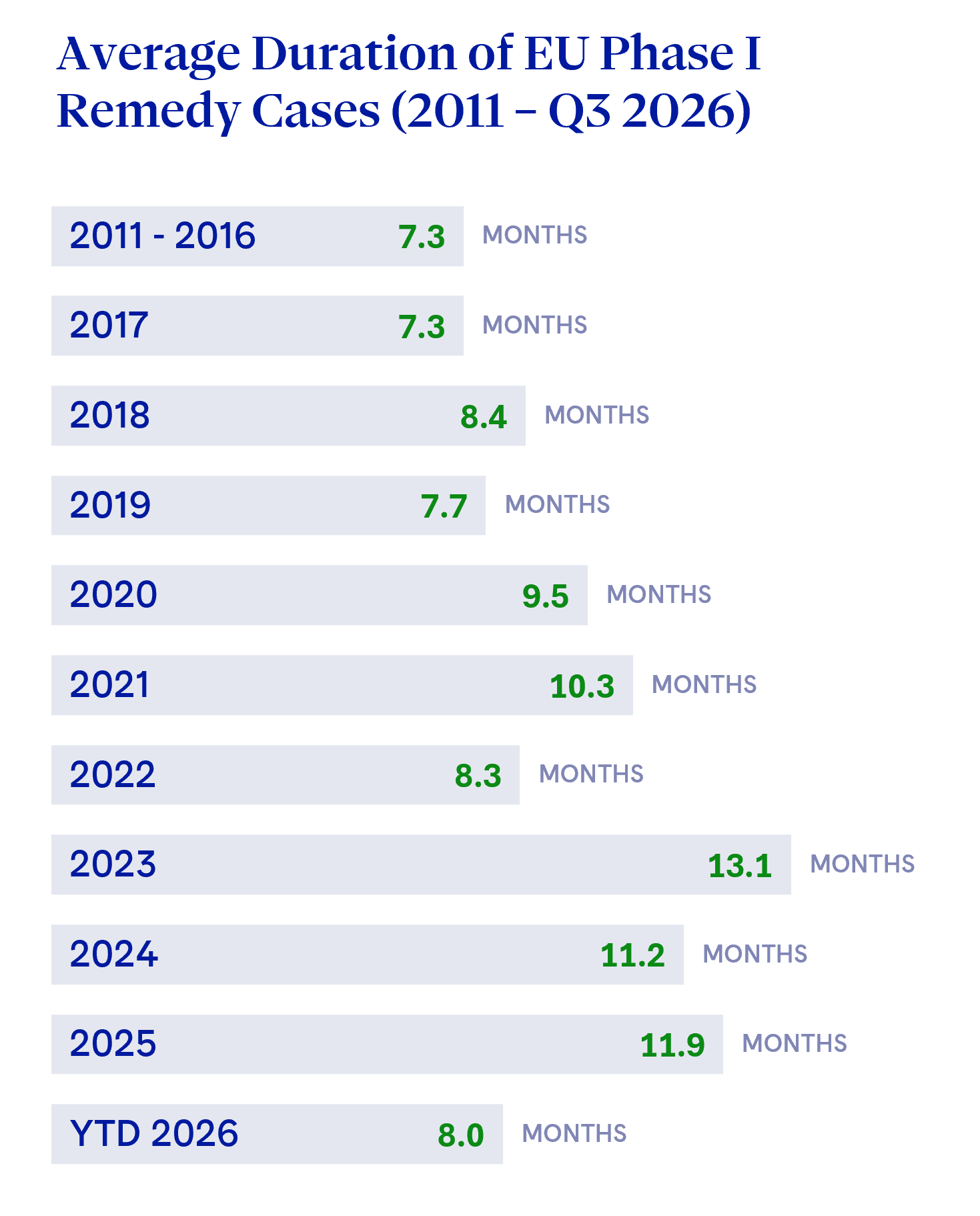
- The average duration of EU Phase I proceedings stood at 8.0 months year-to-date 2026, a level that remains low compared to prior years. The two Phase I decisions adopted in Q3 2026 show sharply different timelines: 11.4 months for Baker Hughes/Chart and approximately 4.8 months for Paramount/Warner Bros. Discovery.
United States
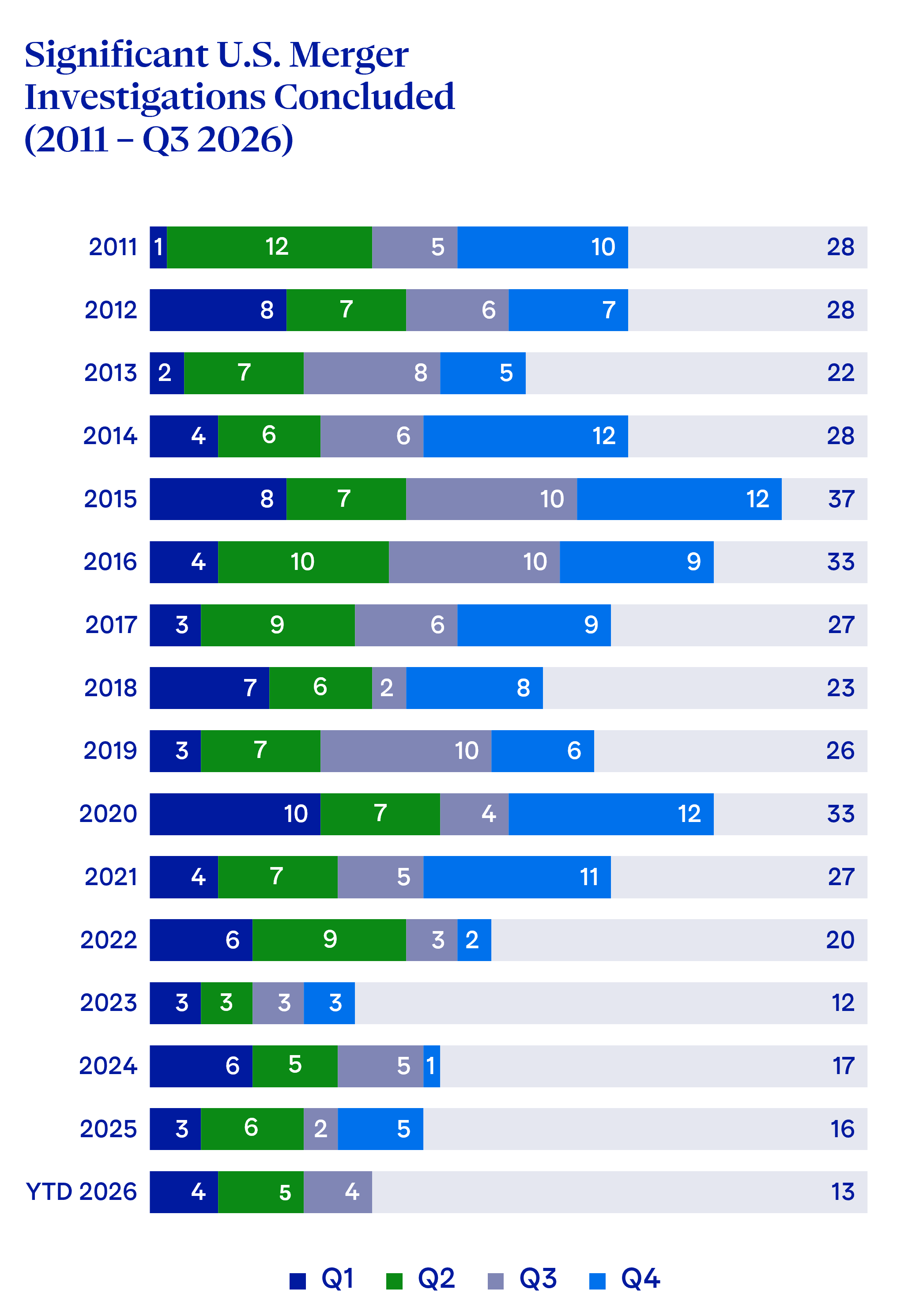
U.S. Significant Merger Enforcement Continues at a Modest Pace in Q3 2026
Four significant U.S. merger investigations concluded in Q3 2026, bringing the year-to-date (YTD) 2026 total to 13 significant merger investigations. The pace is modestly ahead of the 11 investigations concluded through Q3 2025, but remains broadly consistent with the low levels of merger enforcement activity observed over the past four years. Significant merger investigations are nearly evenly divided between the agencies in 2026 so far, with the Federal Trade Commission (FTC) concluding six and the Department of Justice (DOJ) concluding seven.
Looking ahead, current trends suggest that 2026 will track enforcement levels in recent years. Unless enforcement activity accelerates in Q4, the FTC and DOJ are likely to conclude fewer than 20 significant merger investigations in 2026 for the fourth consecutive year.
Significant Merger Complaints Remain Absent While Agencies Continue to Illuminate Enforcement Thinking Through Closing Statements
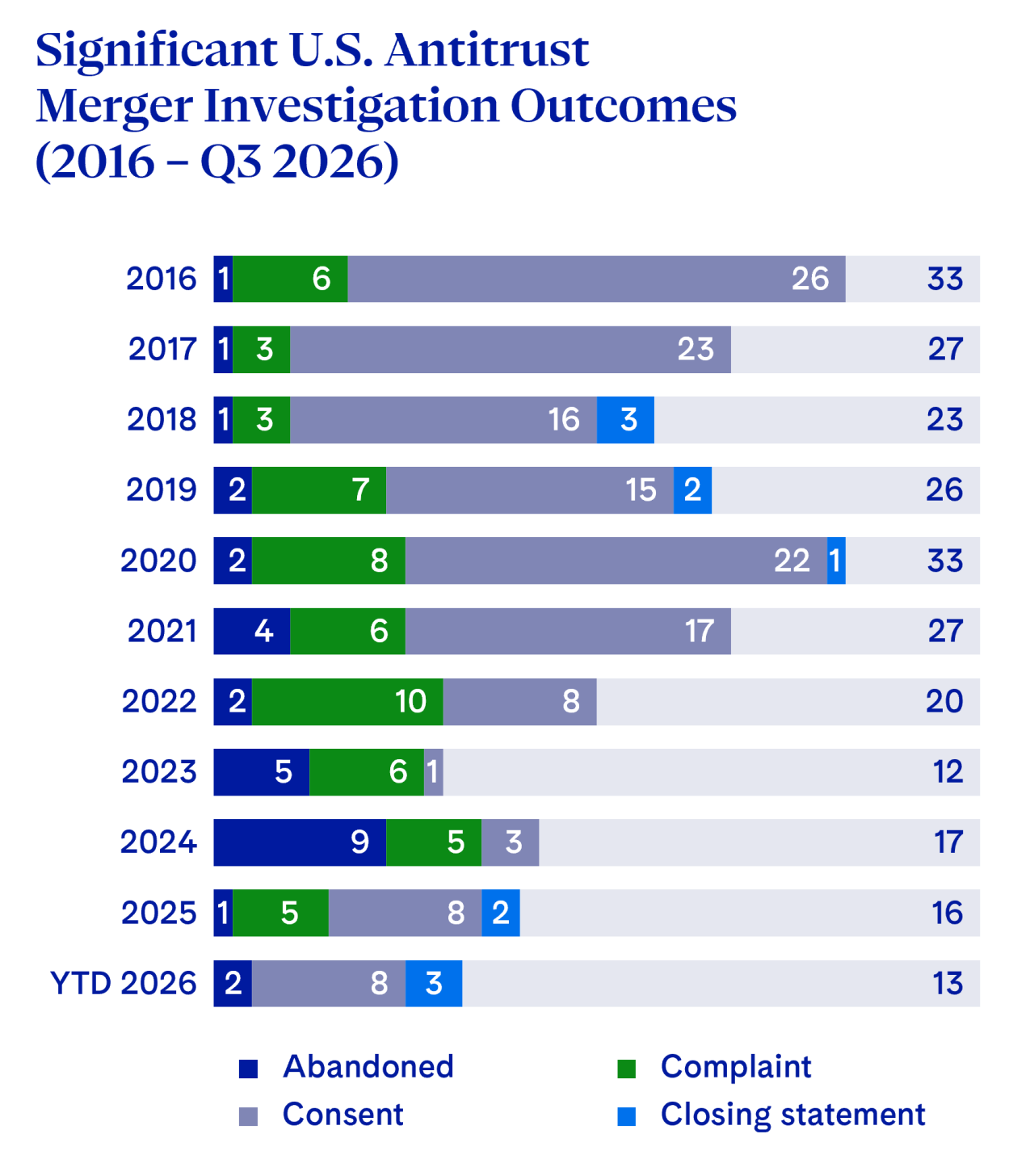
No Merger Complaints Filed Through Q3 2026, While Abandonments Remained Sparse
One notable feature of the 2026 U.S. merger enforcement landscape through the first three quarters is the absence of any new litigated merger challenges. Extended gaps between merger challenges are not unprecedented, however. During the first Trump Administration, the FTC and DOJ went approximately 15 months spanning portions of 2018 and 2019 without filing a contested merger complaint. Likewise, during the Biden Administration, the agencies went roughly 13 months spanning portions of 2020 and 2021 without bringing such a challenge.
The lack of contested merger complaints tells only part of the story. DOJ took credit for the agencies’ second merger abandonment of the year. In July, TransDigm abandoned its proposed acquisition of Stellant Systems after DOJ informed the parties that it was prepared to file suit to block the transaction, citing concerns that the merger would eliminate competition for certain defense-related components and leave the Defense Department dependent on a single supplier for critical products.
Settlements and Closing Statements Continue to Shape Merger Enforcement under Trump II
In Q3 2026, the agencies resolved one significant merger investigation by consent and two significant merger investigations by issuing a closing statement permitting the deals to close without any conditions. In the APAC/Standard Construction transaction, DOJ along with the Tennessee Attorney General required divestitures of two hot-mix asphalt plants to resolve their competitive concerns. DOJ characterized the resolution as a “model for how government works better when federal law enforcers collaborate with states in protecting local interests from competitive harm.” The matter also serves as a reminder that state attorneys general remain a source of merger enforcement risk as states continue to challenge transactions or seek remedies beyond those pursued by the federal agencies. Merging companies therefore should continue to assess potential state-level concerns alongside federal antitrust review.
Beyond settlements, the agencies under Trump II have increasingly relied on closing statements to communicate their views on competitive harm, evidentiary standards, and enforcement priorities.
Most notably, FTC Chair Andrew Ferguson and Commissioner Mark Meador issued separate closing statements in the IonQ/SkyWater transaction, with Chair Ferguson indicating that he would have preferred a negotiated settlement to address vertical foreclosure harms rather than closing the investigation without any remedy. Chair Ferguson emphasized that federal courts generally view vertical integration favorably and noted the government’s limited success in recent vertical merger litigation. Nevertheless, Chair Ferguson stressed that vertical mergers can present genuine competitive concerns and remain appropriate targets for enforcement where the evidence warrants intervention. In his view, however, the IonQ/SkyWater transaction created only short-term risks of foreclosure and those concerns were likely to diminish over time as rivals transitioned to alternative suppliers and new supply entered the market. Accordingly, Chair Ferguson stated he favored a behavioral remedy to address those near-term risks while preserving the merger’s anticipated long-term innovation benefits. By contrast, Commissioner Meador concluded that the evidence did not support a finding that the transaction may substantially lessen competition. Meador emphasized that SkyWater represented only a small share of available supply, was not a “must-have” supplier, and operated in a market characterized by multiple competitors and alternative sources of capacity. With a deadlock between the only two sitting Commissioners, neither position commanded a majority, and the FTC therefore allowed the deal to close without taking any enforcement action.
DOJ’s closing statement in Seismic/Highspot is also notable because it provides one of the first public examples of DOJ’s recently announced “Expedited Consideration” process in action. As discussed in the Q2 2026 DAMITT Report, DOJ’s new approach permits parties to make targeted Second Request productions focused on potentially dispositive issues as part of an accelerated review process. Here, DOJ explained that it entered into a timing agreement with the parties that prioritized evidence relating to AI-driven entry and repositioning, ultimately concluding after a focused three-month investigation that the transaction did not warrant further scrutiny. DOJ cleared the transaction just over six months after it was announced, significantly shorter than the annual average duration over the last decade. The matter therefore may offer an early indication that DOJ is willing to resolve some investigations without requiring full Second Request compliance when a targeted review of key issues is sufficient to evaluate and resolve competitive concerns.
Finally, although not counted as a significant merger investigation by DAMITT, the FTC’s review of OhioHealth’s proposed acquisition of Fairfield Medical Center (FMC), and FMC’s subsequent decision to pursue a transaction with an alternative acquirer, is noteworthy. Chairman Ferguson and Commissioner Meador issued a statement highlighting the importance of a robust “shop” process when financially distressed firms seek to rely on a failing firm defense, emphasizing that targets should make good faith efforts to identify less anticompetitive alternatives before pursuing a transaction that may substantially lessen competition. The statement also suggests that the FTC may be willing to seek a re-shopping process rather than immediately resorting to litigation where concerns center on the adequacy of the target’s search for viable alternative buyers.
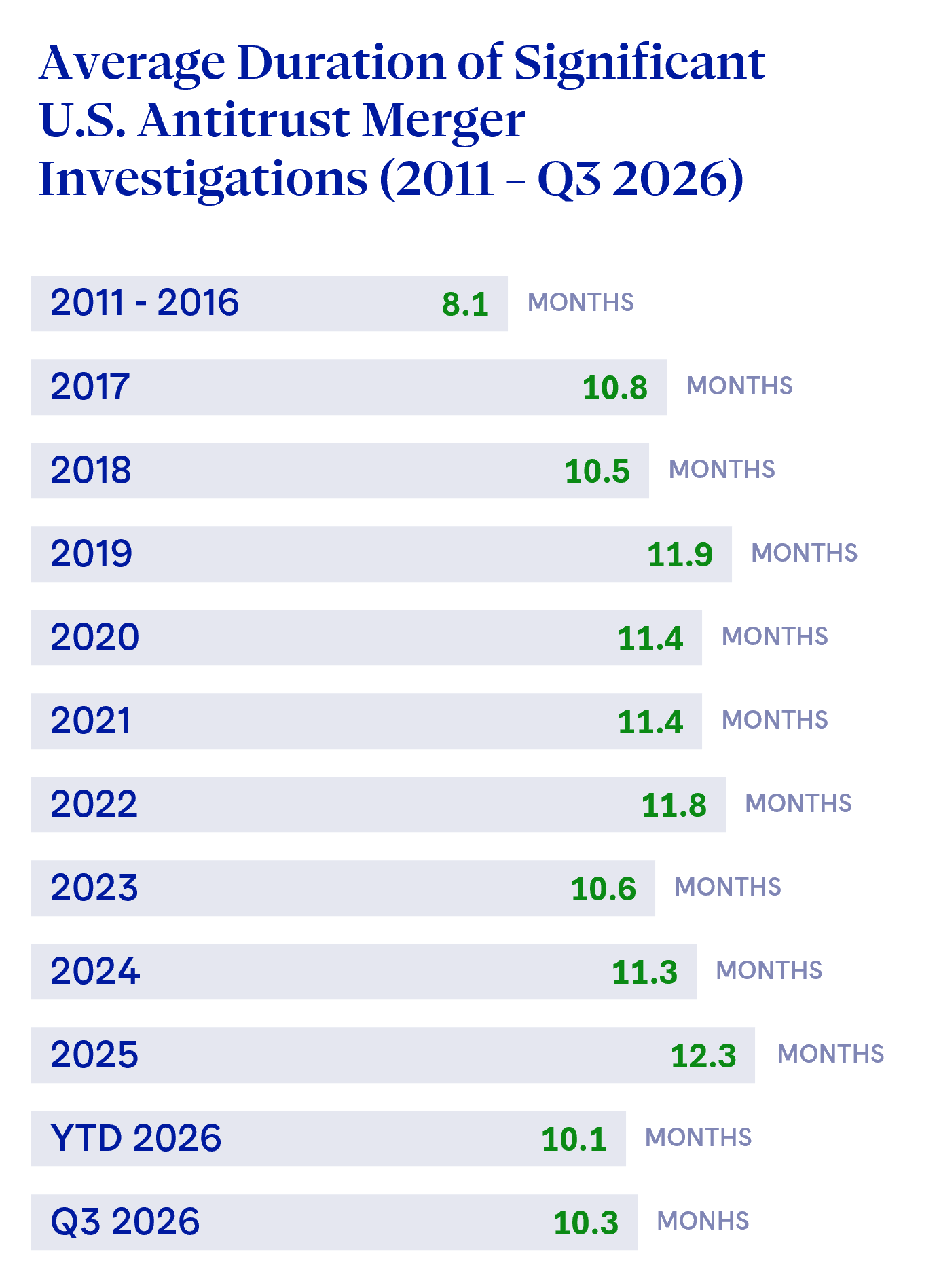
Investigation Durations Remain Near Multi-Year Lows
The average duration of significant merger investigations ticked up modestly in Q3 2026. Through the first half of the year, significant merger investigations concluded in an average of 9.2 months, well below the 12.3-month average in 2025. By the end of Q3, the YTD 2026 average increased to 10.1 months, but that increase largely was driven by the conclusion of a single investigation that lasted more than 22 months. The other three investigations resolved during the quarter each concluded in a little more than six months. Even with the Q3 increase, 2026 remains on pace to record the shortest average duration since 2018 and continues the recent downtrend from the extended review periods observed in 2024 and 2025.
European Union
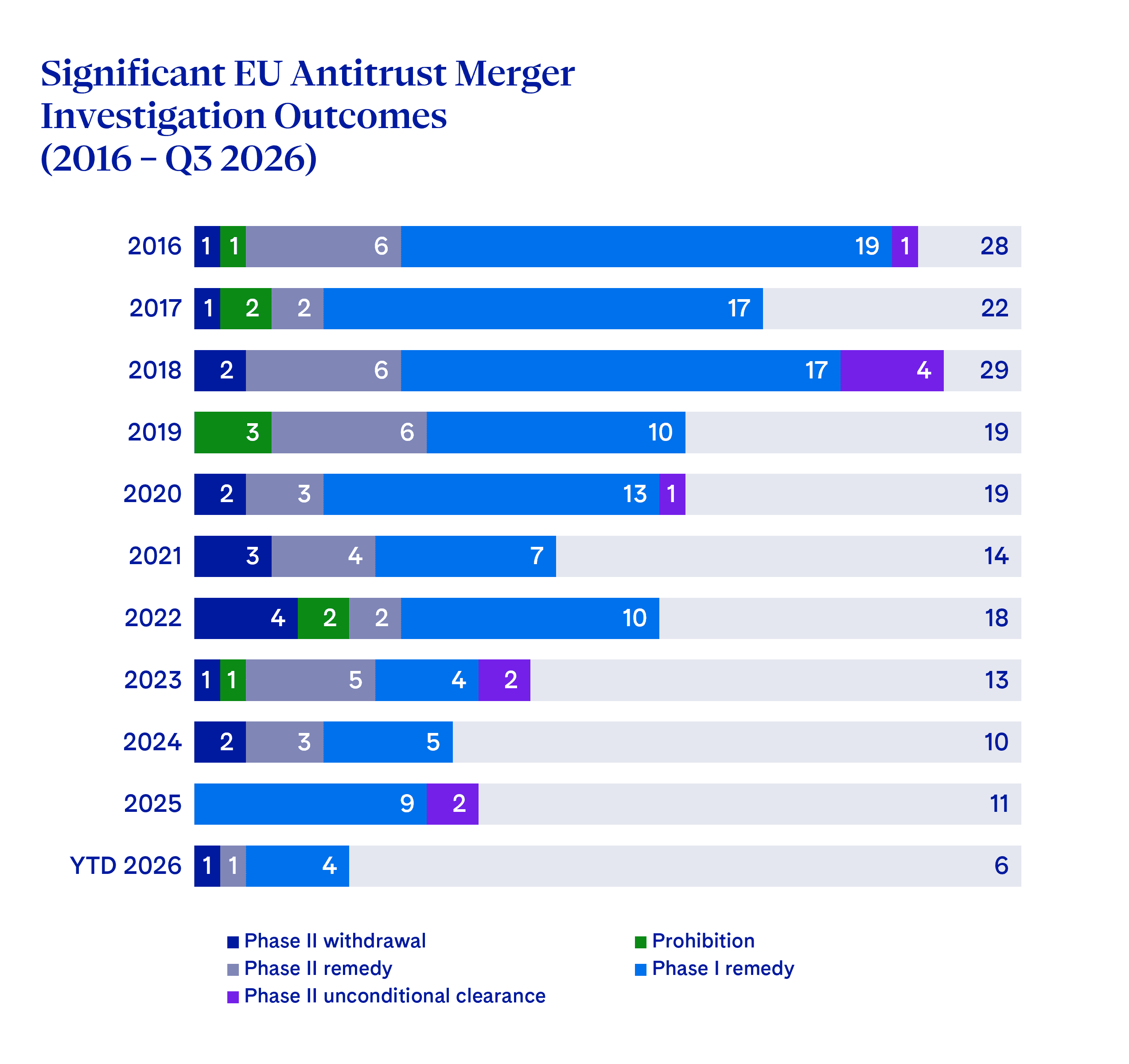
A Modest Quarterly Uptick in an Otherwise Record-Low Year, Driven by Two Notable EU Phase I Clearances and a Phase II Withdrawal
After a particularly subdued start to the year, EU merger enforcement activity picked up slightly in the third quarter of 2026.
The cumulative number of significant outcomes for the year now stands at six, with three investigations concluded in the third quarter alone: two Phase I clearance decisions with commitments (Baker Hughes/Chart Industries cleared on 10 July 2026 and Paramount/Warner Bros. Discovery cleared on 22 July 2026) and one Phase II withdrawal.
Overall, the 2026 total of six significant merger outcomes includes four Phase I and one Phase II decisions with remedies, as well as one Phase II withdrawal. Should the fourth quarter continue at the same pace, the full-year total would reach only eight significant decisions — the lowest level since DAMITT began recording in 2011.
EU Significant Investigations Remain Below the Historical Average
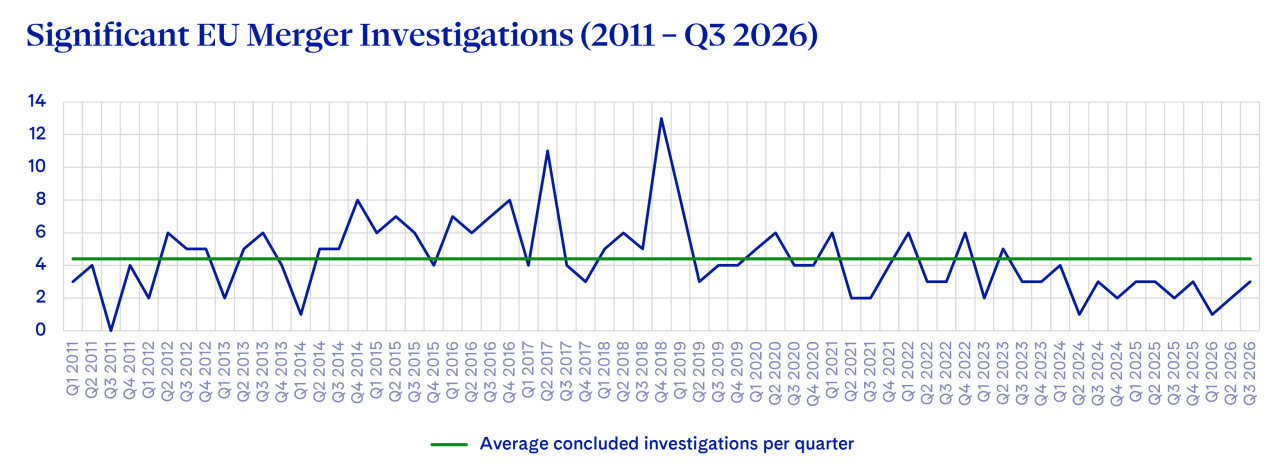
Three significant investigations concluded in Q3 2026, a modest recovery from the first half of the year, but still below the long-term average of 4.4 investigations recorded per quarter since 2011. Five years ago, the average stood at five investigations, pointing to a gradual decline in recent years.
The sole Phase II outcome this quarter ended with a withdrawal, in Case M.11811 - TIL/Hutchison Ports/TerCat, concerning the acquisition of joint control over port infrastructure at the Port of Barcelona in Spain. Although the duration of the pre-notification period remained fairly standard at approximately eight months, the case turned out to be lengthy overall.
Following notification on 5 November 2025, the Commission opened a Phase II investigation on 10 December 2025, only to stop the clock on 8 January 2026, 12 working days after the beginning of Phase II. Pursuant to Article 11(3) of the EU Merger Control Regulation, this mechanism, increasingly used in Phase II, allows the Commission to suspend the review period where a party fails to respond to an informal information request by the given deadline.
The clock never restarted, with discussions between the parties failing to yield a solution reportedly due to the difficulty of a structural remedy involving a single port infrastructure asset. The parties ultimately chose to withdraw the notification more than 17 months after the announcement of the transaction rather than risk facing a prohibition decision.
This withdrawal came in a quarter which also saw the General Court confirm, on 9 September 2026, the prohibition decision involving the acquisition of the Etraveli Group by Booking.com. The transaction had been blocked three years earlier in September 2023 by the Commission — the last prohibition decision and the first-ever merger block based purely on ecosystem concerns.
Looking ahead, the pipeline currently included only three Phase II investigations, following the opening in Q3 2026 of an in-depth investigation into the Saipem/Subsea7 merger in July 2026 concerning the subsea umbilicals, risers and flowlines (SURF) services sector.
Also of note this quarter is the European Commission’s decision to decline jurisdiction to review the acquisition by Iliad of certain assets from SFR, in the context of the nearly $23 billion carve-up of SFR's assets between Iliad, Bouygues Telecom, and Orange — an alleged four-to-three merger in the telecommunications sector. Out of the three concentrations, only the Iliad acquisition was reportable to the Commission, which upon Iliad’s request agreed to refer the matter to the French Competition Authority, where the other two already have been notified.
In its referral decision, the Commission distinguished this case from six precedents over the past 10 years where it retained jurisdiction, noting that referral requests in the mobile telecommunications sector were previously presented at an advanced stage of the investigation, often post-notification, whereas Iliad’s request was submitted less than one month after the transaction's announcement. According to the Commission, retaining jurisdiction would inefficiently duplicate a review that would largely take place in France with the two other transactions (Orange/SFR and Bouygues Telecom/SFR) already notified to the French Competition Authority.
Phase I Average Duration Stays Contained in Q3 2026, With a Sharp Contrast Between the Quarter’s Two Cases
The average duration of Phase I proceedings stood at 8.0 months year-to-date 2026, a level that remains low compared to prior years. The two decisions of the quarter, however, show different trajectories.
The main case of the quarter was Paramount/Warner Bros. Discovery, which was notified on 2 June 2026 and cleared on 22 July 2026. From the final announcement of 27 February 2026, the review took only around 4.8 months to conclude. This deal had, however, been preceded by several months of a bidding war with Netflix for control of Warner Bros. Discovery, suggesting that the parties’ counsel likely prepared the notification well ahead of formal announcement.
The competition concern in this $111 billion transaction was horizontal: combining Warner’s film portfolio with Paramount’s stake in United International Pictures (UIP), a distribution joint venture with Universal which handles the distribution of Paramount’s and Universal’s films for release in cinemas across several countries, allegedly would have increased both market concentration and market transparency at the distribution level to the detriment of cinema operators. Paramount committed to exiting UIP in the EEA within 13 months of closing and agreed to a 10-year commitment not to co-distribute films with Universal or route Warner’s or Paramount’s films through a distributor also used by Universal or Disney within the former UIP countries. Following a positive market test, the Commission concluded that these commitments were sufficient to remedy its concerns and cleared the transaction.
In Baker Hughes/Chart, the timeline was more conventional and closer to the average of the last three years. The deal was announced on 29 July 2025 and formally notified the Commission on 21 May 2026. The Commission cleared the transaction subject to conditions on 10 July 2026. In total, the review spanned 11.4 months from announcement to decision.
The Commission’s concern was that Baker Hughes could exploit its dominant position in the market for LNG compressor trains to unfairly advantage Chart’s LNG business over its rivals. The remedy package consisted of a 10-year commitment, with one main structural component requiring the divestiture of Chart’s proprietary process technology (IPSMR) and its small-scale process technology business supplemented by a behavioral element to ensure the interoperability of the parties’ equipment with third-party LNG equipment.
Conclusion
United States
Q3 2026 closed with four significant U.S. merger investigations. To ensure the ability to defend their deals through a potential investigation, parties to a “significant” U.S. merger investigation should plan on about 10 months for the agencies to complete their review of the transaction. Although more deals are being settled under the current administration at the conclusion of investigations, parties should also consider allocating an additional 6-12 months in their transaction agreements if they want to preserve their right to litigate an adverse agency decision, for a total of 16-22 months from signing.
European Union
Q3 2026 closed with three significant EU merger outcomes — two Phase I remedy clearances and one Phase II withdrawal — bringing the year-to-date total to six. The merger pipeline remains thin, with only three active Phase II investigations as of the end of Q3 2026.
The quarter’s two Phase I decisions illustrate how review periods can vary significantly: Baker Hughes/Chart took approximately 11.4 months from announcement to decision, while Paramount/Warner Bros. Discovery was concluded in roughly 4.8 months, likely resulting from early engagement with the Commission prior to filing.
Looking ahead, all eyes will be on the Commission’s revised Merger Guidelines, which remain on track for finalization by the end of the year and are expected to reshape the landscape of EU merger control for years to come.

Register Your Interest for the DAMITT 2026 Year in Review Webinar
Date and details to be announced soon.
Register HereRelated Professionals






The authors thank Mohamed Mameche for contributing to this report.

Subscribe to Dechert Updates