DAMITT Q2 2026: Merger Timelines Shorten and EU Updates Merger Guidance

July 30, 2026
DAMITT, the Dechert Antitrust Merger Investigation Timing Tracker, is the leading source of analysis for significant U.S. and EU antitrust merger investigation and litigation trends.
Key Facts
United States
- U.S. merger enforcement remains consistent with the pace over the past four years but remains below historical levels.
- Agencies continue to favor negotiated resolutions over litigation, reaching seven merger settlements through Q2 2026 while filing no new merger challenges.
- U.S. significant merger investigation timelines continued to improve in Q2 2026, with the average duration in the first half of 2026 more than two months shorter than the 2025 average.
- State attorneys general continue to play an increasingly active role in merger review, particularly where federal agencies decline to challenge a transaction.
European Union
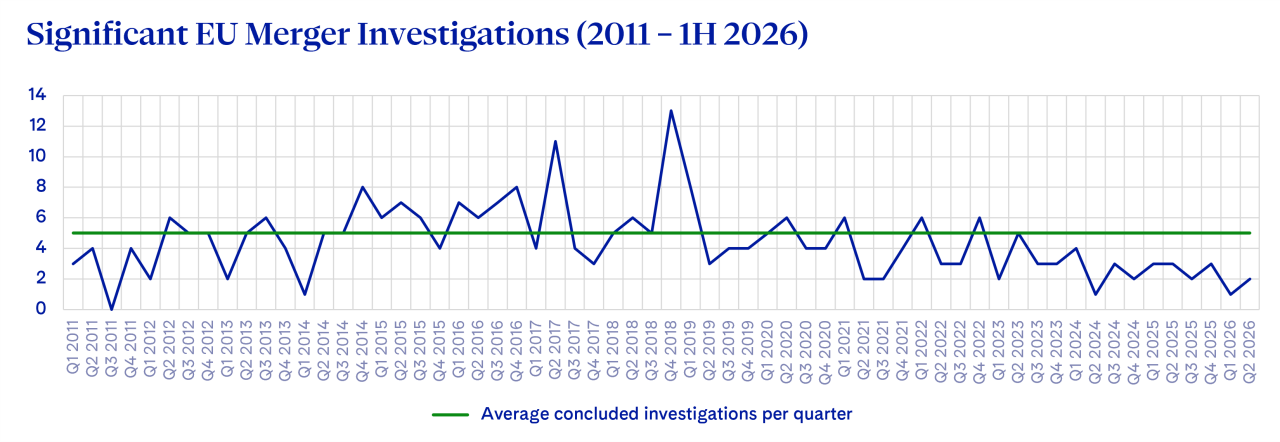
- 1H 2026 recorded only three significant EU merger investigations, the lowest first-half total since DAMITT began tracking in 2011, with one Phase II clearance with remedies in Q1 and two Phase I remedy clearances in Q2.
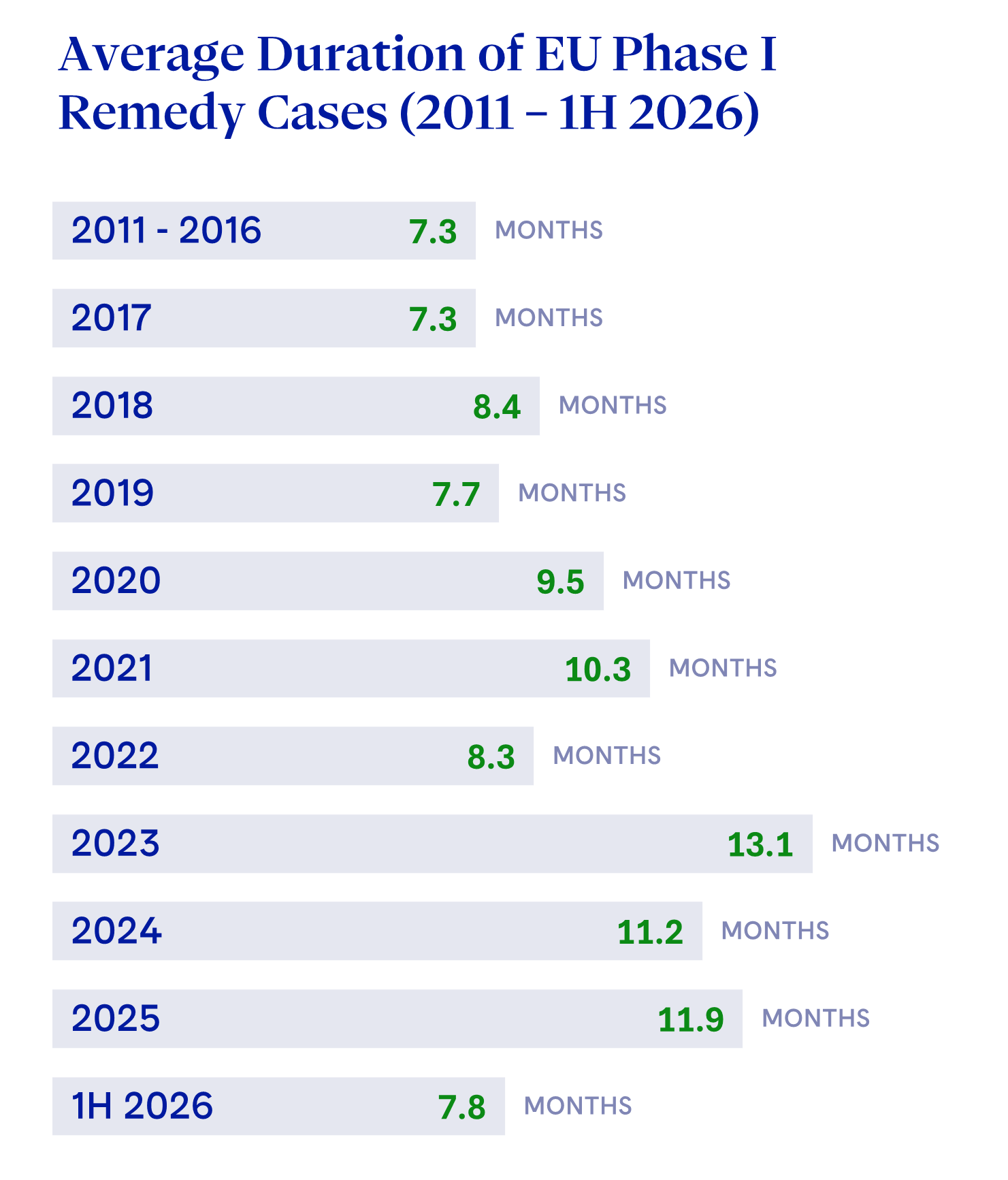
- The two Phase I remedy cases concluded in Q2 2026 closed in approximately 7.8 months from announcement to decision, well below the 2025 average of 11.9 months.
- The Commission opened one new Phase II investigation during Q2, bringing the total of ongoing in-depth investigations to three, with some pickup in decisional activity expected in H2 2026 and early 2027.
- On 30 April 2026, the Commission published the draft text of its revised Merger Guidelines — its most far-reaching proposed overhaul of EU merger control in more than twenty years. A public consultation closed on 26 June 2026, with publication now anticipated toward the end of 2026.
United States
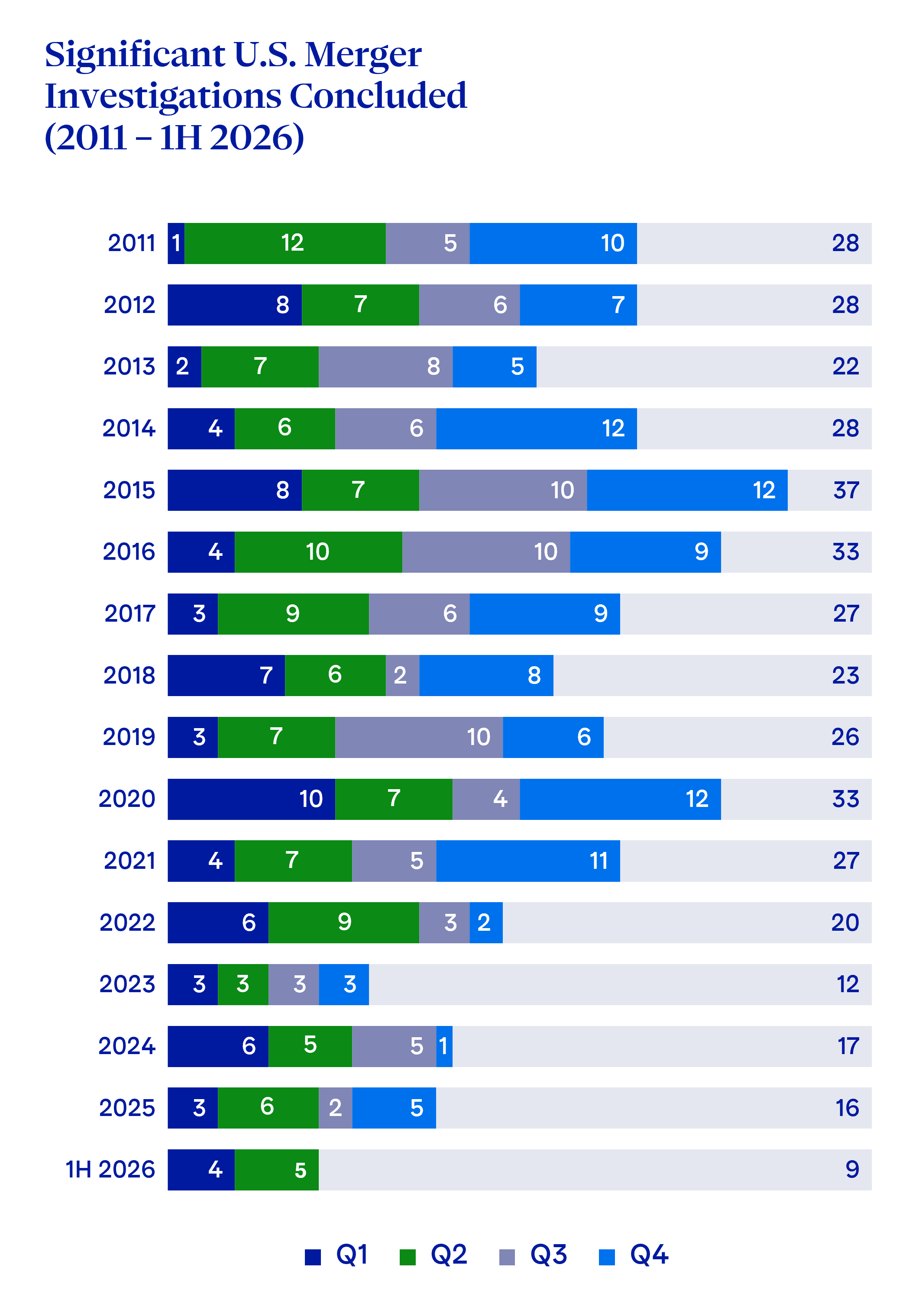
U.S. Merger Enforcement Activity in 2026 Holds Near Recent Levels but Remains Below Historical Averages
Five significant U.S. merger investigations concluded in Q2 2026—three by the Federal Trade Commission (FTC) and two by the Department of Justice (DOJ)—bringing the total to nine for the first half of 2026. The 2026 volume is consistent with levels observed over the past four years, but it remains below historical levels. Since 2011, the agencies have concluded nearly 12 significant merger investigations, on average, during the first half of each year. By comparison, the first-half average during the first Trump administration was thirteen significant merger investigations, peaking at 17 in 2020.
At the current pace, the agencies are on track to exceed the level of significant merger enforcement activity observed over the past three years. However, the trajectory remains uncertain. In 2025, the agencies also concluded nine significant merger investigations during the first half of the year, but activity slowed in the second half, resulting in a year-end total of 16 significant merger investigations.
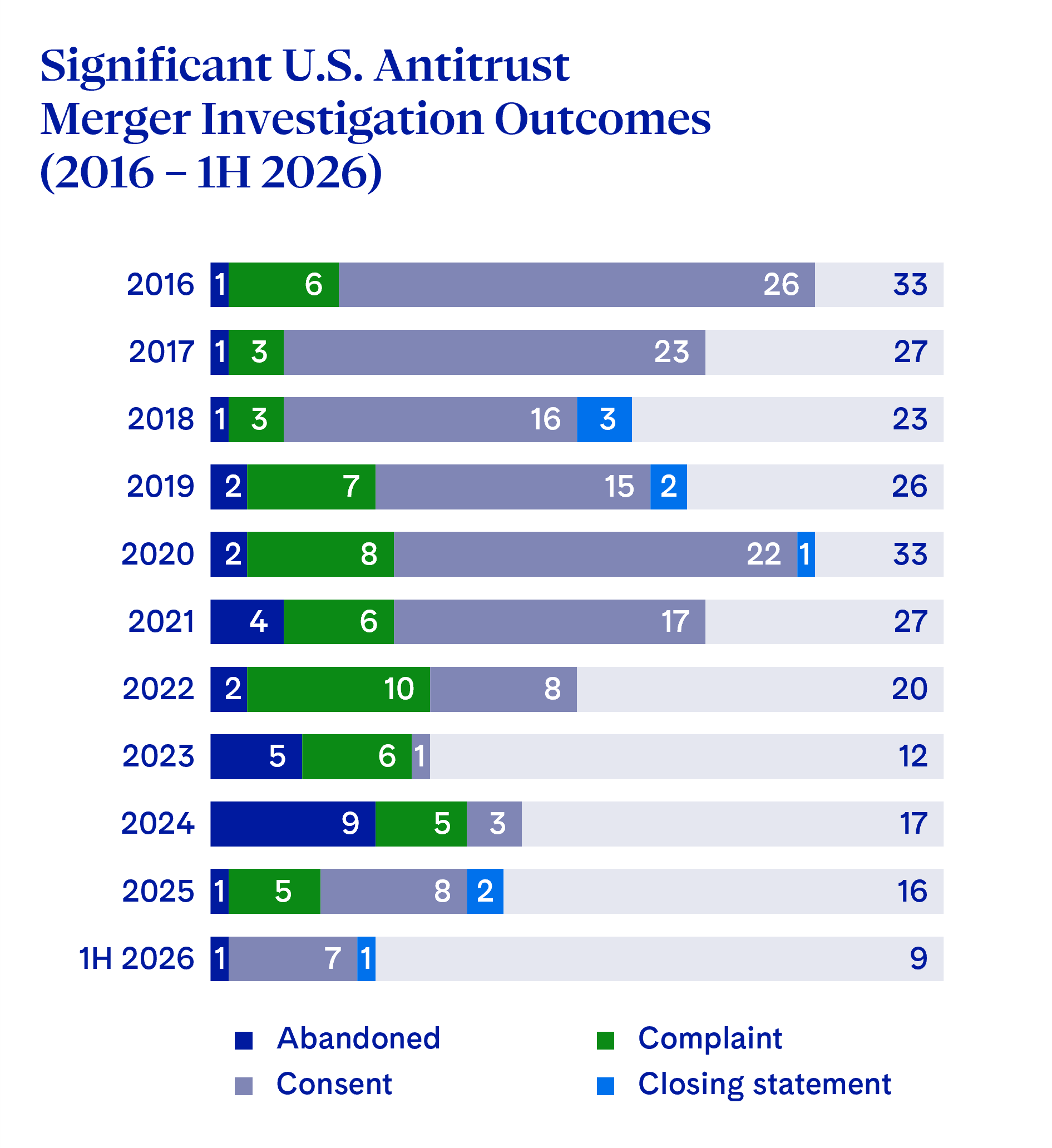
Merger Enforcement Without (Much) Litigation: Settlements and Closing Statements Take Center Stage
The good news for dealmakers and companies pursuing M&A is that the agencies have continued to show a greater willingness to resolve competition concerns through negotiated settlements rather than litigation. Through the first half of 2026, the agencies have already settled seven significant merger investigations, nearly matching the eight total settlements reached during all of 2025.
In the second quarter of 2026, DOJ closed another significant merger investigation with a relatively rare closing statement. Across both terms, the Trump administration has issued nine closing statements, providing an increased level of transparency compared to the Biden administration, which issued none. Most recently, DOJ issued a relatively extensive closing statement in Paramount Skydance/Warner Bros. Discovery following an eight-month investigation. DOJ ultimately concluded that the merger would provide consumers with “a more robust competitive alternative” to larger streaming platforms and thereby enhance competition. The Paramount closing statement builds on themes articulated in DOJ’s closing statement in T-Mobile/UScellular last year (discussed in the Q3 2025 DAMITT Report), suggesting a greater willingness by DOJ to credit broader procompetitive benefits when evaluating mergers. Following DOJ’s clearance, a coalition of state attorneys general sued to block the transaction, continuing a recent trend of states pursuing merger challenges where federal antitrust agencies have declined to do so. Last March, several states also sued to block the Nexstar/Tegna merger after DOJ had cleared the deal.
The federal agencies’ willingness to resolve merger concerns through settlements is also reflected in the absence of new merger litigations. In 2026 to date, the agencies have yet to file suit to block a transaction. The FTC’s December 2025 challenge to the Henkel/Liquid Nails transaction remains the most recent contested merger litigation. Trial began on July 13, making it the first—and currently the only—merger challenge to proceed to trial involving a transaction announced in 2025, and therefore reviewed entirely under the current Trump administration.
For dealmakers, the first half of 2026 provides further evidence that meaningful engagement with the agencies can result in negotiated resolutions rather than courtroom battles. At the same time, recent state challenges—including to transactions cleared by federal enforcers—underscore that engagement with state attorneys general can be equally important.
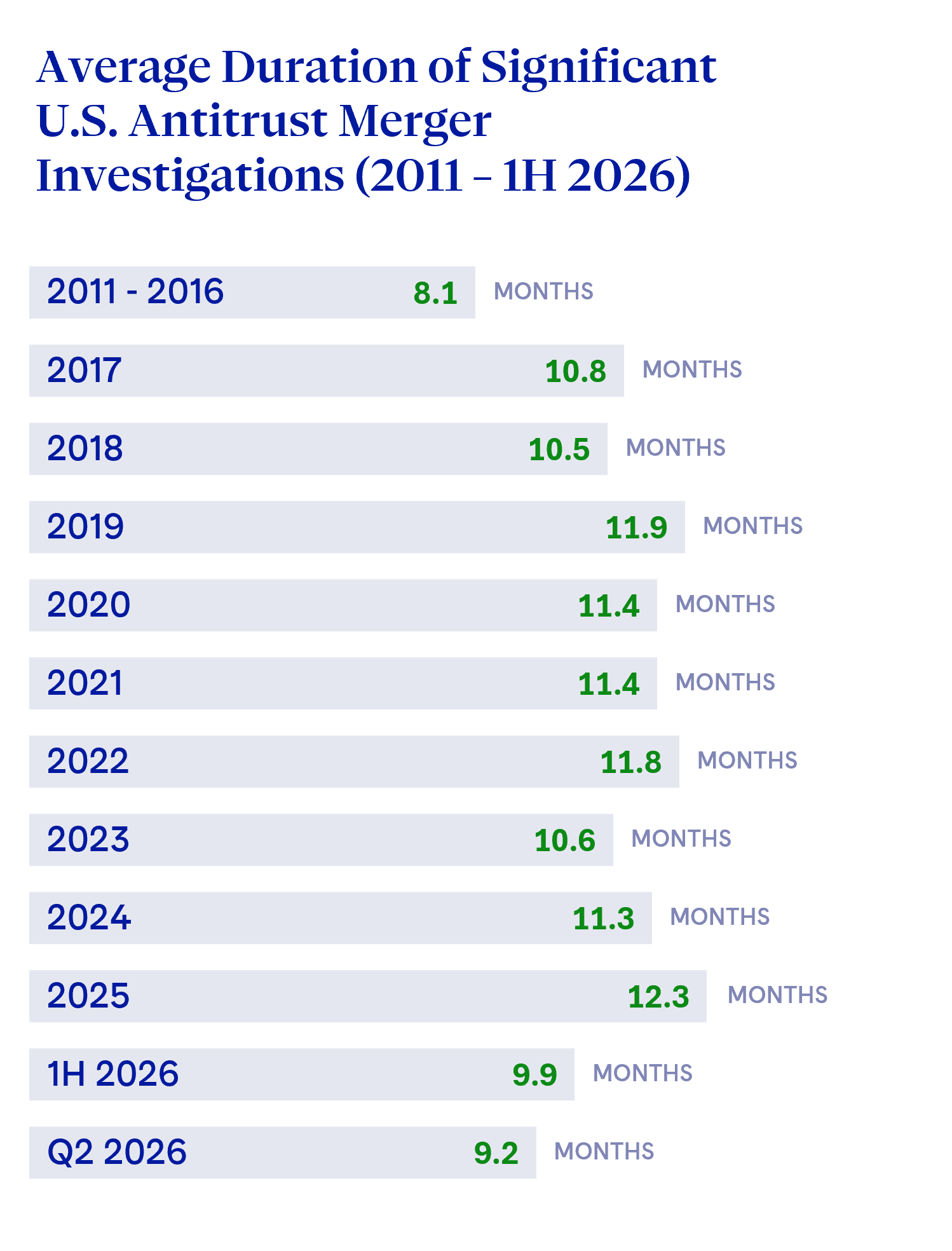
Significant U.S. Merger Investigation Durations Continue Downward Trend Through Midyear
Continuing the trend of welcoming news for dealmakers, the average duration of significant U.S. merger investigations concluded in Q2 2026 was 9.2 months, more than a month shorter than the 10.8-month average recorded in the first quarter. For the first half of 2026, significant U.S. merger investigations averaged 9.9 months, more than two months shorter than the average duration for all significant U.S. merger investigations concluded in 2025. The year-to-date median investigation duration is 10.8 months, compared with a median of 11.6 months in 2025.
For transactions announced in 2025 and reviewed entirely under the current Trump administration, the average investigation duration stands at 9.8 months. As discussed in the 2025 Annual DAMITT Report, the agencies began showing signs of faster review periods in Q4 2025 after clearing out a backlog of significant investigations commenced under the prior administration. At that time, however, the sample size was limited. With twelve significant U.S. merger investigations involving 2025-announced transactions now completed through Q2 2026, there is growing evidence that investigation timelines are trending downward under the current administration.
Furthering this effort to reduce merger review timelines, DOJ recently announced an optional “Expedited Consideration” process that offers merging companies an opportunity to make targeted Second Request productions focused on potentially dispositive issues. Following that priority production, DOJ commits to an accelerated review process culminating in a decision roughly five weeks later on whether to close the investigation, narrow it or proceed with a full review. DOJ has stated that the process “will allow for quicker and more efficient review of proposed transactions.” DAMITT will continue to track the impact of this new process in future quarters.
European Union
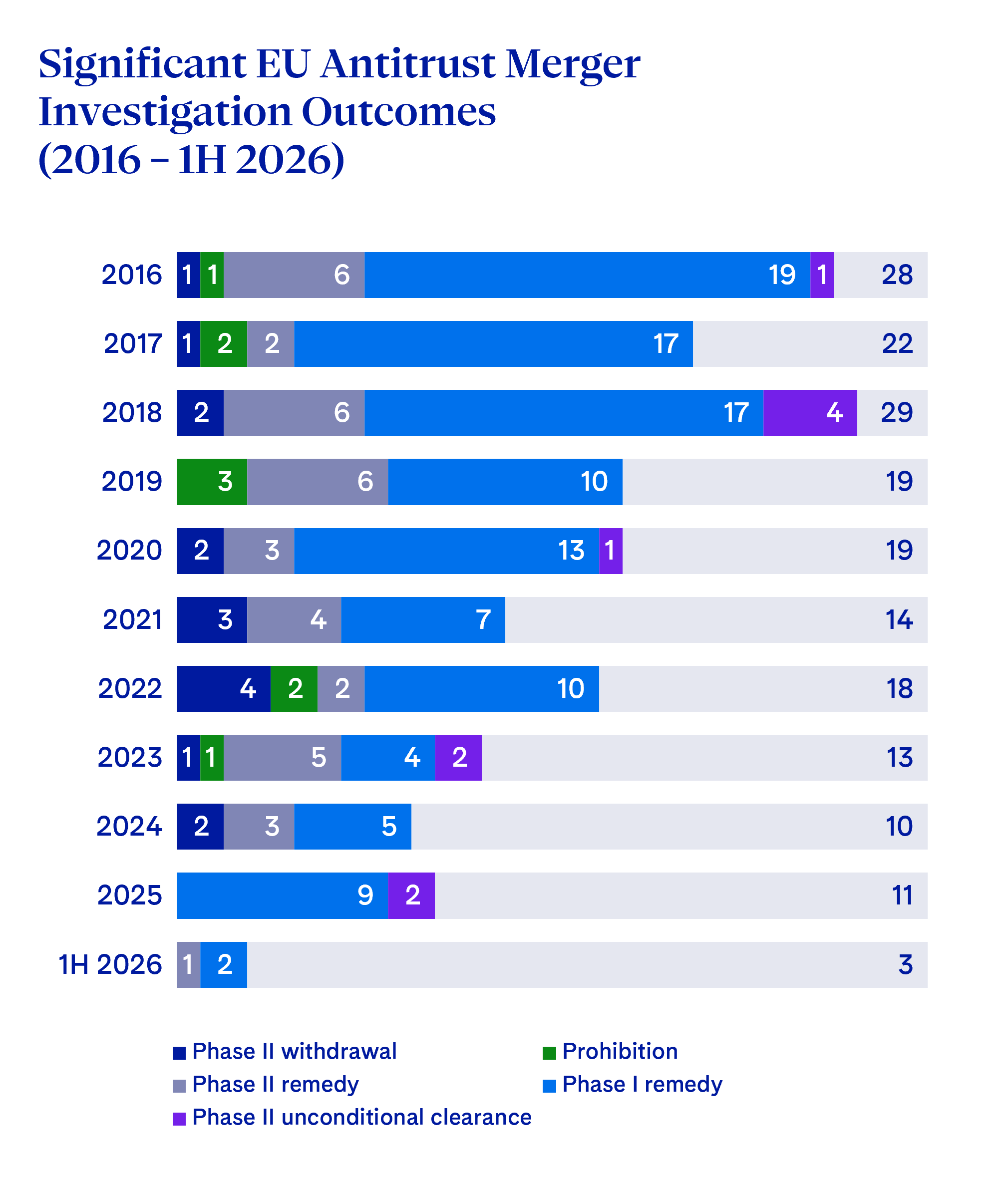
A Quiet Half-Year on the Enforcement Front, While the Rulebook Gets an Overhaul
1H 2026 stands out less for case-related developments than for policy direction. On 30 April 2026, the Commission published its draft revised Merger Guidelines – its most far-reaching proposed overhaul of EU merger control in more than twenty years.
On the merger enforcement front, activity picked up marginally in Q2 2026 relative to Q1 but remained extremely faint. Only two significant decisions were recorded in the quarter, both Phase I remedy clearances, bringing the 1H 2026 total to three.
With no Phase II decision issued in Q2 and one new in-depth investigation opened during the quarter (UPM-Kymmene/Sappi/JV), the pipeline now stands at three. As such, some pickup in Phase II decisional activity in H2 2026 and early 2027 can be expected.
Still Falling: 1H 2026 Posts the Lowest First-Half Total on Record
With three significant investigations concluded in 1H 2026, the lowest first-half total since DAMITT began tracking in 2011, the Commission is on track to shatter 2024’s record low of ten. This compounds a broader trend: 1H 2025 had itself produced just six outcomes, already a near-record low, and no first half since 2020 has exceeded the long-run H1 average of approximately nine. The pipeline offers little reason to expect a sharp reversal in 2H.
Back to Speed? Phase I Remedy Cases Post Their Fastest Timelines Since 2019
The two Phase I remedy decisions of the quarter (Carlyle/BASF Coatings and Holcim/Xella) stand out for their speed. Both cases closed in approximately 7.8 months from announcement to decision, well below the 2025 average of 11.9 months and the 2024 average of 11.2 months, and close to the 2011–2016 baseline of 7.3 months. As ever, a sample of two warrants caution; but the contrast with the persistently elevated timelines of 2023–2025 is notable.
One explanation could lie largely in procedural simplicity. Each case ran the standard 35-working-day Phase I clock (25 working days, with 10 additional days where commitments are offered) without extension.
Both deals were notified in April 2026, roughly five months after signing in October 2025. Neither required an upfront buyer remedy, a condition that in Phase I averaged 5.3 months of additional post-clearance delay over the 2019–2025 period, as highlighted in the DAMITT 2025 Annual Report.
The underlying theories of harm differed sharply. In Carlyle/BASF Coatings, the concern was vertical: Carlyle, which already held one of only two global suppliers of aerospace polysulfide sealants in its portfolio, acquired BASF Coatings, a downstream user of that critical input. With no viable alternative supplier and prohibitively high switching costs, input foreclosure risk was a key concern. The remedy, full divestiture of the polysulfides business, including a production site in Germany, eliminated the vertical link outright. In Holcim/Xella, the concern was horizontal and geographically contained: both parties were leading suppliers of concrete blocks in Romania. This was resolved by the targeted divestiture of Holcim’s Adjud plant in Romania. In both cases, a well-scoped, single-asset remedy and a positive market test enabled the Commission to close within the standard Phase I window and keep the timeline short.
A Framework Renewed: Draft Merger Guidelines Mark the Most Significant Reform in Two Decades
On 30 April 2026, the European Commission published the long-anticipated draft of the new EU Merger Guidelines, opening a public consultation that closed on 26 June 2026. This marks “the most significant reform in EU merger control of the past two decades,” according to the Commission. The new guidelines will replace both the 2004 Horizontal and 2008 Non-Horizontal Merger Guidelines with a single unified framework. Following an extensive stakeholder consultation process launched in May 2025, publication of the final text is anticipated in Q4 2026.
The draft introduces a substantially expanded analytical framework: rather than relying on a rigid categorization of mergers into horizontal and non-horizontal, the new guidelines center the assessment on a refined toolbox for analyzing different types of merger effects. Among the most notable innovations, the Commission sets out for the first time a comprehensive framework for forward-looking dynamic competitive assessments of a merger’s impact on innovation and investment, while introducing a new category of dynamic efficiencies.
For dealmakers, the practical implications remain to be seen. A more granular assessment of dynamic effects, innovation competition, foreclosure and multi-dimensional efficiencies could require more time, more evidence and more back-and-forth with the Commission. Much will depend on how the Commission operates the new framework in practice and whether it will apply the full analytical toolkit selectively or routinely. DAMITT will monitor closely how the guidelines will affect review timelines. Publication of the guidelines is expected in Q4 2026.
Conclusion
United States
1H 2026 closed with five significant US merger investigations. To ensure the ability to defend their deals through a potential investigation, parties to a “significant” U.S. merger investigation should plan on about 10 months for the agencies to complete their review of the transaction. Although more deals are being settled under the current administration at the conclusion of the investigation, parties should also consider allocating an additional 6-12 months in their transaction agreements if they want to preserve their right to litigate an adverse agency decision, for a total of 16-22 months.
European Union
1H 2026 closed with only three significant merger outcomes. The two Phase I remedy cases recorded in Q2 concluded in approximately 7.8 months from announcement to decision. These durations should not, however, be taken as the new norm: based on recent trends, parties anticipating a Phase I clearance with commitments should plan for approximately 11–12 months from announcement to decision. Finally, the Commission’s draft revised Merger Guidelines, published in April 2026, are expected to be finalized in Q4 2026.
Related Professionals







Subscribe to Dechert Updates