
I. Executive Summary
If the Collateralized Fund Obligation (“CFO”) market has been having its moment, the rated note fund (“RNF”), whether structured as a fund or a feeder fund, has been doing the same work with less fanfare but comparable velocity. The RNF market has grown substantially, with 2025 issuance volumes among KBRA-rated funds setting all-time records,1 and KBRA has stated that it expects this growth to continue through 2026.2 As the market now enters its third year of sustained scale, these structures have become prevalent in the private markets.
The RNF became one of the most effective tools in the private capital fundraising toolkit because it elegantly solves a specific issue: it allows insurance companies, and other regulated investors, to obtain economic exposure to a private credit fund by holding a significant portion of their investment as debt rather than as limited partner (“LP”) equity interest, for regulatory capital purposes. That ability to structure a portion of the interest as rated debt is key to understanding why the market has grown so fast and where it is heading.
II. What Is a Rated Note Fund — and Why Does It Matter for Capital Formation?
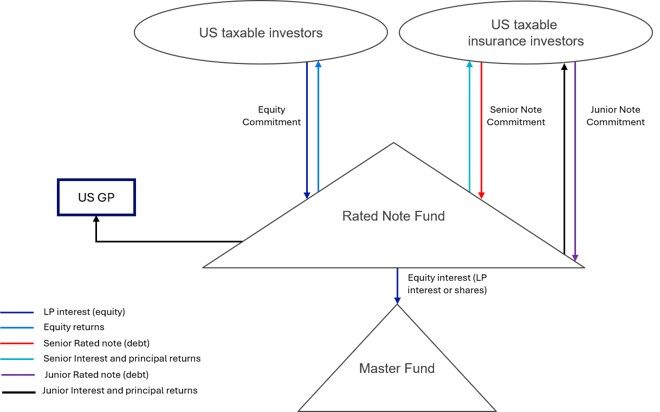
A RNF is a special purpose vehicle that raises capital from investors by issuing rated debt (and unrated equity) and uses the proceeds to either invest directly into credit, direct lending, infrastructure, or other private market assets or, as a rated note feeder fund, to make a commitment as an LP to an underlying master fund (as shown by the chart below). In both cases, the structural logic is the same: the special purpose vehicle issues rated debt supported by subordinated equity, and a priority of payments waterfall governs how investment returns are allocated among the capital stack.
From the manager’s perspective, the RNF is a mechanism for issuing debt collateralized by the fund’s investment strategy, analogous, in structure if not in collateral, to a CLO or other asset-backed financing. The rated notes are leverage applied to the fund’s assets, and the economics of the equity tranche are meaningfully enhanced (or impaired) by the terms on which that leverage is obtained.
The power of the RNF has become particularly relevant in the current capital raising environment where many institutional LPs are receiving fewer distributions from their existing private fund portfolios and are therefore less able to redeploy into new commitments.3 Managers face a narrowed pool of traditional investor capital and are increasingly seeking to tap new sources of institutional capital, including insurance companies and other regulated investors for whom the RNF’s rated debt format is preferable. The RNF is, in this sense, not just a product for insurance investors; it is a capital formation tool for managers navigating a more constrained fundraising market.
III. Why the Market Has Grown
The RNF market’s growth is rooted in a market gap that has existed between what insurance companies need and what the private markets have traditionally offered.
U.S. life insurers are among the largest pools of long-duration institutional capital in the world. They need long-dated, investment-grade assets to match long-duration liabilities, and they are regulated at the state-level under a framework coordinated by the National Association of Insurance Commissioners (“NAIC”), which sets the capital adequacy standards that govern how much surplus an insurer must hold against the risks on its balance sheet. The NAIC’s risk-based capital (“RBC”) framework is the primary tool for this purpose: it assigns a capital charge to each asset an insurer holds, calibrated to the perceived riskiness of that asset, and the aggregate of those charges determines the insurer’s minimum required capital. When an insurer holds an LP interest in a private credit fund, even one whose underlying assets are senior secured loans that would, if held individually, attract a low RBC charge, the investment is treated as equity for RBC purposes, attracting a charge of 30% to 45%. The result is a disconnect between the economic quality of the underlying exposure and the capital cost of holding it, in that the LP bears a capital charge calibrated to equity risk for what is, in substance, a credit return stream.
The RNF converts a portion of the insurer’s economic exposure to the underlying assets into a format that is treated more favorably under the applicable regulatory framework. While the investment portfolio and economics of the underlying investment are unchanged, the structure around the insurer’s participation in it is more favorable. The equity tranche provides the subordination and first-loss protection required to support investment-grade ratings on the senior tranches. In a RNF, the ratings on senior notes can be as high as A, translating into RBC charges as low as 0.7% to 1%, compared to 30% to 45% for a direct LP interest in the same underlying fund.
The NAIC’s principles-based bond definition, which took effect January 1, 2025, provided an important additional catalyst for the RNF market’s growth. The new framework replaced a formalistic approach to bond classification with a principles-based question of whether an instrument exhibits the economic characteristics of a bond. For RNF notes that satisfy these criteria, the definition confirmed eligibility for bond treatment, attracting materially lower RBC charges than equity-like investments. Eighteen months of market experience with the framework has broadly confirmed its applicability to private credit and direct lending-backed RNFs: structures whose underlying fund assets generate periodic, scheduled payments have generally obtained bond treatment. The expectation is that RNFs backed by private credit funds and direct lending strategies will generally qualify for bond treatment, while structures backed by equity-heavy strategies or other strategies with less predictable cash flows require more careful analysis.
IV. How the Structure Works in Practice
The Mechanics
As described above, the RNF issues rated notes and unrated equity (although some lower tranches of notes may also be unrated) to investors. Capital calls are funded by drawing on investors’ commitments in proportion to their note and equity holdings, and distributions generated by the underlying investments, whether from directly held investments or received from the master fund, are applied pursuant to a negotiated payment waterfall.
Vertical vs. Horizontal
The choice between a vertical and a horizontal capital structure is a key decision in any RNF transaction.
The Vertical Structure. In a vertical structure, each investor purchases a proportional slice of the entire capital stack, including both rated notes and equity, in a fixed ratio established at the outset. There is a single commitment, split among the note and equity components in accordance with an agreed ratio. The vertical structure most closely resembles a traditional private fund: the investor is an LP in the underlying strategy, with the rated note and equity components allocating the returns and losses of that investment between notes and an equity piece. The documents governing a vertical structure reflect this fund-like character. The main operative document is typically a limited partnership agreement, coupled with a note purchase agreement that corresponds to the applicable provisions in the limited partnership agreement. Investor complexity is more limited because the note and equity are held by the same entity, and structural protections among classes are inherent in the structure. Consistent with this fund-like character, the rated notes issued in a vertical structure are most commonly unsecured obligations of the issuer, ranking ahead of the equity but without a security interest in the RNF’s assets.
A vertical structure offers certain benefits as compared to its horizontal counterpart. With a single investor or affiliated investors holding the full capital stack, investor negotiations are reduced. Also, vertical structures have been in use longer, and market participants have a deeper comfort level with their mechanics and documentation. The structure can offer an insurance company investor a more capital-efficient way to invest in an existing fund. For managers making their first entry into rated capital markets, or for transactions where execution speed is paramount or where the purpose of the structure is to accommodate a known set of potential investors, the vertical structure offers a more predictable and manageable process.
The fundamental limitation of the vertical structure for insurance investors is that holding equity in a rated vehicle carries a meaningfully higher RBC charge than holding only rated notes. Also, because the investor must take the full stack, vertical structures tend to attract single, large institutional investors or affiliated groups rather than broad market placements with more nuanced and specific needs. This constrains maximum transaction size relative to what a horizontal structure can achieve.
The Horizontal Structure. In a horizontal structure, investors purchase specific tranches of debt and equity independently: senior debt investors acquire only rated debt (which may be in the form of notes, loans or both), equity investors acquire only the subordinated tranche (or a preferred equity layer beneath the notes), and the capital stack is placed tranche by tranche with investors best suited for each specific risk-return profile. Some investors may nonetheless acquire a vertical strip of all classes of the capital stack within a horizontal structure, or may pick and choose. A horizontal RNF looks, from a capital markets and documentation perspective, more like a structured finance vehicle than like a private fund. Reflecting that structured finance character, the rated notes in a horizontal RNF are almost always secured by a first-priority security interest in the assets of the RNF, including the RNF’s LP interest in the underlying master fund.
Because note investors may have no equity exposure, horizontal structures eliminate the primary regulatory barrier for insurance investors who, for regulatory capital reasons, choose not to hold equity. This broadens the potential investor base and is a primary reason horizontal structures now represent a substantial portion of new RNF transactions. By allowing each tranche to be placed with the optimal investor, horizontal structures can achieve larger aggregate transaction sizes than verticals. Billion-dollar-plus transactions are now common in horizontal formats. From a documentation perspective, horizontal structures use indentures or note purchase and security agreements as the primary transaction document, with ancillary credit agreements (to the extent any of the notes are issued in loan format), and intercreditor terms that are more familiar to structured credit investors. Finally, multi-tranche horizontal structures can place Class A, B, C (and in some cases D and E) debt at different rating levels (or even non-rated), allowing the issuer to optimize the cost of capital at each level of the stack.
Like vertical structures, there is a balancing of pros and cons that must be considered when considering a horizontal structure. Most notably, with independent debt investors and equity investors each oftentimes retaining their own counsel and negotiating their own terms, the intercreditor negotiation in a horizontal structure can be more extensive. Execution timelines are materially longer (and typically require an early identification of the potential equity investors) and legal costs are higher than in a vertical.
As noted above, placing the equity tranche with a third party is often the most difficult aspect of a horizontal RNF. Credit-oriented underlying funds tend to generate returns that are attractive to debt investors but less compelling to equity investors seeking levered fund-of-funds-type returns. In practice, sponsors often retain or partially retain the equity tranche, and the process of identifying third-party equity co-investors and negotiating their governance and economic rights has become a critical parallel workstream in large horizontal transactions, where it is more common for placement agents to be involved to support this process.
Multi-Tranche Capital Structures
Consistent with broader market practice, RNF documentation has trended toward multi-tranche debt arrangements. The number of tranches, however, varies by structure type. In a vertical structure, it is rare to see more than two or three classes of rated notes. In a horizontal structure, by contrast, three or four tranches of rated notes are common, five tranches are not unusual, and some transactions also include term loans ranking pari passu with senior class(es) of notes. This multi-tranche approach in the horizontal structure allows issuers to utilize the full ratings spectrum, improving overall economics and broadening the potential investor base.
Subscription Facilities and Sub-Line Support
Subscription credit facilities (commonly referred to as “sub-lines”) have become an important part of the RNF financing toolkit, though the mechanics and availability of sub-line support differ meaningfully between vertical and horizontal structures. A sub-line is a revolving credit facility extended to the underlying master fund and secured by the master fund’s right to call unfunded capital commitments from its investors, providing short-term liquidity to fund investments, bridge the timing between capital calls and distributions from the master fund, and manage cash flow at the master fund level. It is common for managers to obtain borrowing base credit at the master fund level for their rated feeder funds as long as the sub-line lender has the right to always call commitments under the RNF to cure a default on the sub-line. The sub-line lender typically obtains this right through provisions in the relevant funds, which are typically embedded in an equity commitment letter or the RNF’s limited partnership agreement, indenture or other definitive agreement, and which require, among other things, that upon an event of default under the subscription facility and notwithstanding any limitation in the RNF documents, a noteholder in the RNF must fund their note commitment in the form of equity, with a dollar-for-dollar offset against their note commitment. The sub-line lender is generally an express third-party beneficiary of that funding obligation, with the right to issue capital calls directly to the RNF’s noteholders and to enforce the equity conversion mechanic without set-off, counterclaim, or bankruptcy-based defense.
In a vertical structure, each investor’s commitment funds both the debt and equity components of the capital stack in a fixed ratio, so sub-line lenders are generally more willing to give borrowing base credit for the full commitment on terms broadly similar to those available to traditional private funds and investors are more often comfortable with the related provisions required by a sub-line lender. In a horizontal structure, sub-line lenders are typically less willing to give the same borrowing base credit for debt-only commitments, in part because a debt investor is less likely to fund an equity-style call upon a subscription facility default. Notwithstanding that limitation, horizontal RNFs do obtain sub-line support through a combination of structural mitigants, including the requirement that noteholders fund their notes in the form of equity upon a sub-line event of default. From the note investor’s perspective, key structural protections include hard limits on sub-line size and tenor, priority arrangements in the payment waterfall, and intercreditor terms with the sub-line lender.
ERISA Related Matters. Accounts subject to the fiduciary responsibility provisions of the U.S. Employee Retirement Income Security Act of 1974, as amended (“ERISA”) and those subject to the prohibited transaction rules of Section 4975 of the Code (collectively “Plans”) frequently access funds directly or through one or more feeders. Feeders are often used, for example, to mitigate potential unrelated business taxable income (“UBTI”) related considerations. While it is possible to structure a RNF to be “ERISA compliant,” the features of RNFs are less "ERISA friendly." Because RNFs raise additional compliance complexities and, more importantly, higher prohibited transaction risks when compared with more traditional feeders, most RNF sponsors choose to avoid any Plan participation in RNFs. However, one important exception to this general rule is for those insurance company general accounts that may be deemed to constitute Plan assets and be subject to ERISA.4 Most insurance company general accounts that are subject to ERISA are able to bypass many of the complexities and incremental increases in prohibited transaction risk that accompany “regular” Plan investments in a RNF.5 They are thus often the ideal investor for RNFs precisely because they not only offer favorable commercial and regulatory benefits but because, alone among Plan accounts, their specific contours are able to stay clear of those challenges that other Plan investors would bring to the table.
V. The Regulatory Framework
NAIC: Bond Eligibility and the Securities Valuation Office’s Expanding Role
In addition to the NAIC’s principles-based bond definition discussed in Section III, the NAIC has been expanding its oversight of how those notes are rated and whether privately assigned ratings provide a reasonable basis for favorable regulatory capital treatment.
In August 2024, the NAIC passed an amendment authorizing the NAIC’s Securities Valuation Office (the “SVO”) to challenge credit ratings on filing-exempt securities where it determines they do not provide a reasonable assessment of investment risk for regulatory purposes (the “Discretion Amendment”). While the Discretion Amendment’s original January 2026 implementation date was subsequently delayed,6 it has sharpened regulatory focus on private letter ratings and the appropriateness of favorable RBC treatment for instruments rated privately rather than through a public process.
Concurrently, a filing-exempt process reform that did take effect January 1, 2026, authorizes the SVO to review and remove a credit rating agency (“CRA”) rating from filing-exempt status if the SVO determines the rating does not provide a reasonable assessment of investment risk for regulatory purposes. If removed, the SVO assigns its own NAIC designation (and corresponding RBC charge) to the security, with potentially material consequences for insurance investors holding the notes.
In January 2026, the NAIC established a Credit Rating Provider (“CRP”) Working Group to develop a formal due diligence framework for the NAIC’s reliance on CRA ratings in assigning designations. On May 4, 2026, that Working Group proposed the CRP Due Diligence Framework for comment, signaling that independent NAIC scrutiny of rating agency methodologies will increase. Regulatory trends are clear: sponsors and their counsel should engage proactively with rating agencies before issuance and, on an ongoing basis, ensure that rating rationale reports satisfy evolving standards, and monitor regulatory developments closely as the NAIC’s framework continues to develop.
U.S. Risk Retention
The analysis of whether U.S. risk retention rules apply to a RNF is substantially similar to the analysis undertaken for a CFO (see Dechert's CFO Market Update 2026). Most practitioners take the position that risk retention does not apply where the underlying fund holds LP interests in private equity or private credit funds, on the grounds that such LP interests are not "self-liquidating financial assets" within the meaning of the U.S. Securities Exchange Act of 1934’s definition of asset-backed security. However, this analysis is fact-specific and sponsors should confirm the applicability of risk retention with experienced counsel that has extensive knowledge of the U.S. risk retention criteria. Factors to be considered will include the composition of the fund’s portfolio, whether the RNF holds assets directly or indirectly, and how the assets in question were transferred into the structure, if at all.
EU and UK Securitisation Regulation
Whether a RNF constitutes a “securitisation” within the meaning of the European Union (“EU”) and United Kingdom (“UK”) securitisation regulations is a fact- and structure-specific analysis which often but not always turns on whether the transaction involves a tranching of credit risk. If it does, the full suite of EU securitisation requirements applies, including 5% risk retention, disclosure, transparency, and ongoing monitoring obligations. RNFs that invest in a European-based master fund, are marketed to European or UK investors or are managed out of Europe require careful risk retention analysis, and the determination will depend heavily on both the structure of the RNF and of the fund’s investment strategy. In this context, the ban on resecuritisation in UK and EU legislation means that particularly careful consideration needs to be given to funds that have exposure to ABS and other asset classes that are treated as securitisations under the EU or UK rules.
EU Solvency II and Solvency UK
European insurance investors face a different regulatory calculus than U.S. insurance companies. Under Solvency II, the general requirement for a look-through to the underlying fund exposures, rather than treatment based on the rating of the note, can produce capital charges approaching those applicable to a direct equity investment for equity-heavy portfolios if the issuance is structured so that the insurer is treated as investing in a fund. For this reason rated note offerings to European insurance investors often use a different issuance structure compared to the typical US issuers, for example, with the issuer structured as a parallel investment vehicle or a permanent investment company. The position for UK insurers is more favorable following the UK’s reform of the matching adjustment framework under Solvency UK, which extended matching adjustment eligibility to assets with “predictable” (rather than strictly “fixed”) cash flows. Credit-oriented senior debt with predictable cash flows and make-whole provisions is now being regularly purchased by the major UK insurers. As a result of these regulatory drivers, offering terms for rated notes suitable for EU/UK investors will differ significantly from those that are common for the US insurance company market, and as a result, single issuance Delaware RNFs are rarely suitable for EU/UK insurance companies. For those firms who are looking to attract multiple investors, these diverse requirements are driving the development of issuance platforms either in the form of master trusts or medium term note (“MTN”) programs that can offer series of debt with different profiles to different investors.
Tax Considerations
Tax issues can arise at multiple points in the lifecycle of a RNF, including those around the choice of jurisdiction and entity type for the RNF, the proper tax characterization of the rated notes as debt or equity, effective connected income considerations for non-U.S. investors, passive foreign investment company and subpart F exposure for U.S. investors, and UBTI considerations for tax-exempt investors. Tax structuring for a RNF should be viewed as an extension of the underlying fund tax structuring, particularly for the RNF equity investors. It is important to consult tax counsel to ensure that the RNF does not adversely alter the tax suitability of an investment in the underlying fund vis-à-vis the equity investors.
VI. Emerging Trends
Broadening Collateral Types. RNFs were initially developed primarily for closed-end private credit and direct lending funds. The market has since expanded significantly: underlying funds now include open-end and evergreen credit vehicles, infrastructure funds, real estate credit strategies, multi-strategy private credit platforms, and hybrid structures that combine private credit with equity co-investments. We have also seen increased emphasis on rated note structures that invest into multiple funds managed by the same manager, or that may hold a portion of their investments directly and a portion as LP interests in an existing master fund. The ongoing question for each new collateral type is whether the underlying cash flows are sufficiently predictable and senior enough to support the desired ratings. This determination requires early engagement with the rating agencies and careful portfolio modeling.
Real Estate Strategies. Real estate credit strategies have emerged as a meaningful and growing frontier. Rating agencies are increasingly willing to engage on rated feeders backed by real estate debt funds, though the approach and constraints differ across agencies and the nature of the specific real estate portfolio assets targeted by the applicable RNF.
Multi-Tranche Horizontal Structures. The shift from vertical to horizontal capital structures, and from simple two-class to multi-tranche arrangements, has been the dominant structural trend in the RNF market over the past two years. As more tranches are added and intercreditor terms become more complex, RNF documentation is increasingly converging with structured finance conventions, a development that improves investor familiarity and could, over time, support a more liquid secondary market for rated RNF notes. Multi-tranche structures are also prevalent when using the rated notes as a means to finance a specific transaction, i.e., situations where a rated note issuer (typically bankruptcy remote) is not a feeder fund but rather a financing vehicle below the master fund.
Convergence with the CFO Market and Secondaries Exposure. As we have noted in our CFO Market Update, the boundary between the RNF and the CFO markets is becoming less distinct. Both structures are negotiated with the same rating agencies, tested against the same insurance investor base, and built from the same structural toolkit. Horizontal RNFs are highly similar to CFOs in documentation, capital structure mechanics, waterfall design, and investor dynamics, one primary difference being that a CFO holds multiple underlying fund interests whereas a RNF generally holds interests in a single fund. Multi-tranche horizontal structures that first became standard in the CFO market have migrated into RNF documentation; coverage test mechanics and collateral eligibility standards from the RNF context are common CFO structures. The borrowing is bidirectional, and the pace of convergence has accelerated over the past twelve months as the same deal teams execute across both formats.
The secondaries market has also emerged as a meaningful point of convergence. RNFs are no longer limited to single-fund private credit vehicles: a growing number of sponsors are structuring RNFs that feed into secondaries funds and continuation vehicles, providing regulated investors with risk-based capital efficient exposure to a market segment previously accessible only through direct equity investment. This development mirrors the CFO market’s growing focus on secondaries funds and reflects the same underlying demand: insurance and other regulated capital seeking indirect, rated exposure to a broader range of private market strategies, including continuation vehicles (where existing LPs are looking to maintain exposure to a portfolio company or strategy beyond a traditional fund’s wind-down date). The RNF structure, in this context, can serve a dual purpose by providing the manager with a capital formation tool and simultaneously providing existing LPs with a liquidity mechanism, allowing them to receive a cash exit from their LP interest while the insurance investor steps in through the rated feeder.
Geographic Expansion. While the RNF market originated in the United States (specifically with Delaware-domiciled RNFs), it is by no means exclusive to U.S.-domiciled structures. A significant portion of RNF vehicles are domiciled in the Cayman Islands, which offers familiar fund infrastructure, flexible corporate law, and a well-established offshore regulatory framework that has long been used for private fund feeders. Several European private credit managers have launched RNFs targeting UK and European insurance capital, particularly in light of the Solvency UK matching adjustment reforms, Cayman issuance vehicles remain the most common choice for these offerings, although other jurisdictions may be considered depending on the target investor base.
There has been growth in the number of purchasers outside of the UK, Europe and US. South Korean insurers, subject to the Korean Insurance Capital Standard (K-ICS), have also emerged as an active and growing source of RNF demand. The K-ICS framework’s treatment of rated debt instruments on terms broadly comparable to the NAIC’s approach has created incentives for Korean life insurers to access private credit returns through rated note structures, and several U.S. and European sponsors have begun actively marketing RNF programs to Korean institutional capital. In addition to Korea, we have also seen offers targeted at banks or insurers in Canada, Australia, Japan, Thailand, Hong Kong and United Arab Emirates.
Multi-issuance platforms. Another way of reducing issuance costs particularly where there are going to be multiple investors and several issuances, is to establish a programmatic issuance platform. These structures may take the form of master trusts or MTN programmes and while these structures are newer and, accordingly, the set up costs are higher than for a single stand-alone structure, they may offer material efficiencies for those who expect to have routine issuances.
VII. Considerations for Sponsors
Sponsors evaluating the RNF as a fundraising tool should consider the following practical points before beginning the structuring process:
- Anchor Investors. Given the cost and complexity of establishing a RNF, having one or more committed anchor investors before launch is beneficial. Without an anchor, there is meaningful execution risk that the structure will not achieve the scale required to make the cost-benefit calculus work.
- Rating Agency Engagement. Rating agencies should be engaged early, ideally before definitive fund documents are drafted and definitely before the terms are negotiated with investors, to confirm that the proposed structure and underlying fund strategy are ratable and to understand the key assumptions and stress scenarios the agencies will apply. Changes to fund documents required to support the rating can take time to negotiate and should not be left until late in the process.
- Early Coordination Across Workstreams. A RNF touches fund formation, structured finance, insurance regulation, tax, ERISA, and fund finance simultaneously. Late engagement of any one of these disciplines creates risk. For sponsors establishing RNFs alongside European master funds, an early jurisdiction analysis (including SPV structuring and EU/UK securitisation regulation analysis) is essential.
VIII. Conclusion
The rated note feeder has moved from a niche capital-raising tool to a standard feature of the private capital toolkit. The structural framework is well-developed, the rating agency methodologies for private credit markets are established, the insurance investor base is engaged and growing, and the range of viable underlying fund strategies continues to expand.
For private capital managers who have not yet seriously evaluated the RNF structure as a capital raising tool, the conditions are as favorable as they have ever been. To borrow from a more celebrated show about ambition, legacy, and the cost of hesitation: don’t throw away your shot.7 The question is not whether the structure works, the market has answered that. It is whether a given sponsor’s strategy, investor relationships, and operational infrastructure make this the right tool at the right time.
Footnotes
- KBRA, “Private Credit: A Breakout Year for Rated Note Feeders and CFOs” (Sept. 17, 2025), https://www.kbra.com/publications/sYCRVyvJ/kbra-releases-research-private-credit-a-breakout-year-for-rated-note-feeders-and-cfos.
- KBRA, “Private Credit: 2026 Outlook” (Jan. 21, 2026), https://www.kbra.com/publications/jhmNKGZY/private-credit-2026-outlook.
- MSCI, “The Distribution Drought in Private Equity Persists” (June 11, 2026), https://www.msci.com/data-and-analytics/private-asset-solutions/visualizations/the-distribution-drought-in-private-equity-persists.
- John Hancock Mut. Life Ins. Co. v. Harris Trust and Sav. Bank, 510 U.S. 86 (1993)
- -This is the case where not more than 10% of the insurance company general account constitutes “Plan assets,” and the insurance company general account is able to rely on one or more institutional prohibited transaction class exemptions (“PTCEs”) such as PTCE 95-60 (specifically designed for insurance company general accounts in the wake of the John Hancock case cited immediately above). It is our experience that insurance company general accounts do not generally at present have a “Plan assets” portion that is at or approaching 10%.
- The systems needed to make the Discretion Amendment’s process operational, and the agreements needed to ensure the security of information and data, are still in the works. NAIC, Valuation of Securities (E) Task Force, Minutes of the December 10, 2025 Meeting (Fall National Meeting, Hollywood, FL), reporting by SVO Director Charles Therriault.
- Hamilton: An American Musical, by Lin-Manuel Miranda.